
Last updated September 20, 2026
Free on-site gate assessment - hinges, posts, and your LiftMaster or Nice gate operator checked before anything is quoted
The assessment is free and the quote is the invoice.
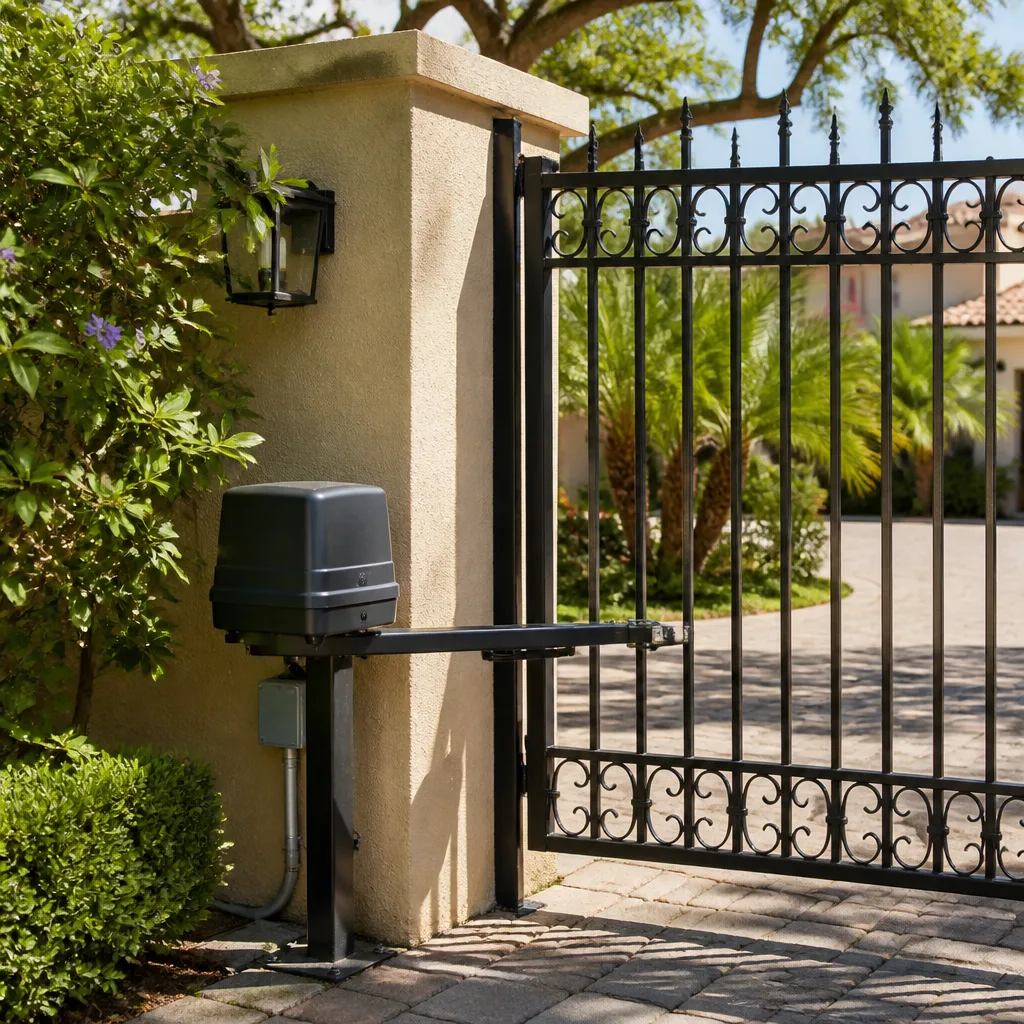
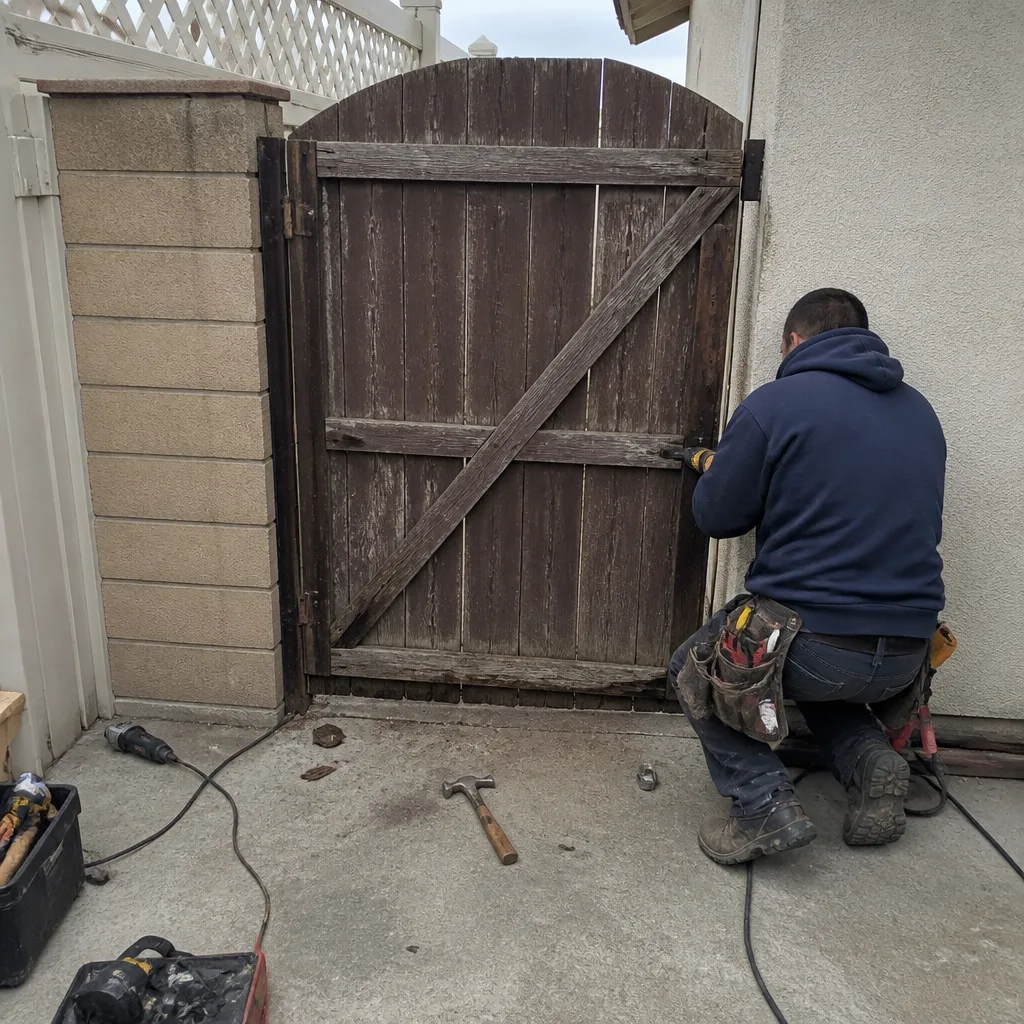 Before
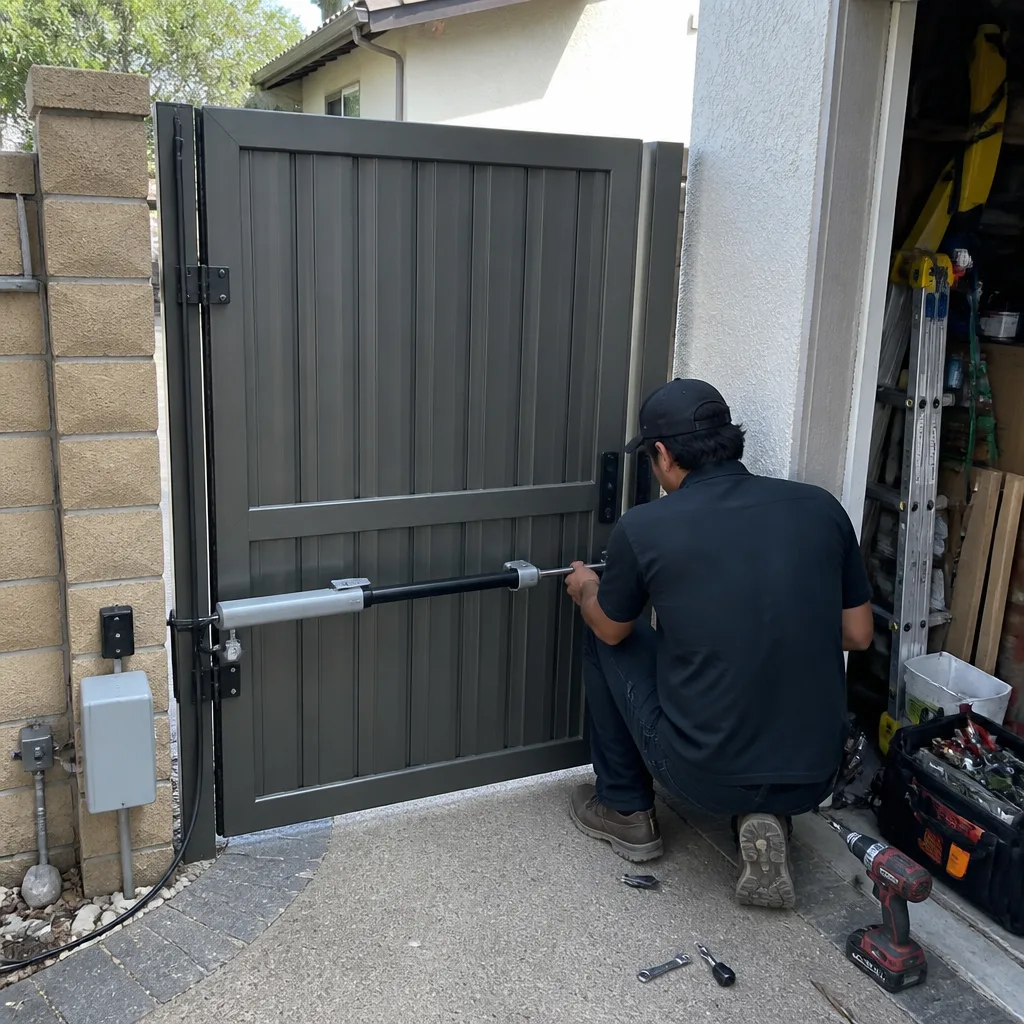 After
After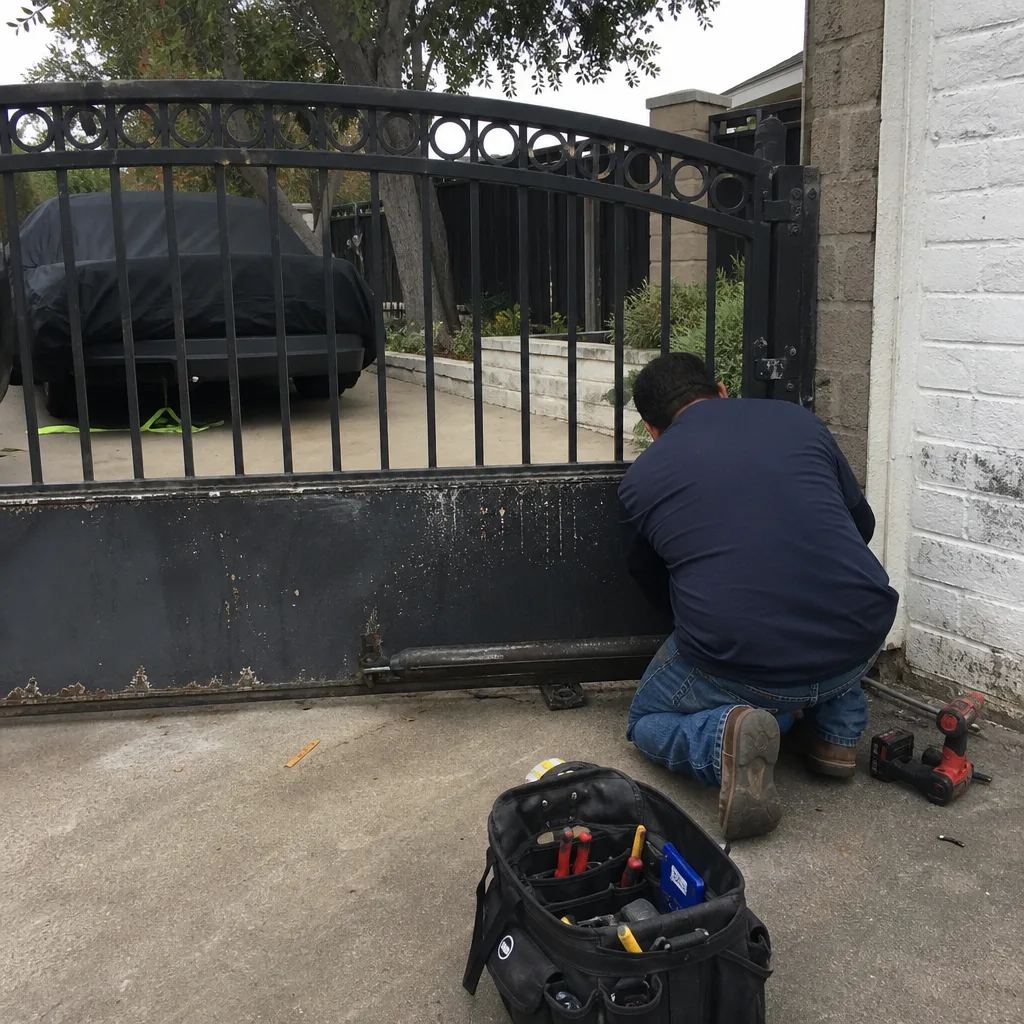 Before
 After
After Before
 After
AfterDIY vs Professional Gate Repair: The Huntington Beach Homeowner’s Decision Guide
The homeowner who replaces a gate circuit board from a YouTube tutorial but doesn’t record the DIP switch settings, wire positions, or limit values has saved $200 today and created a $600 diagnostic problem for the next person who opens that control box – including themselves. We see this pattern regularly in Huntington Beach, where salt air and coastal moisture mean that undocumented repairs degrade faster and fail more expensively than the same work done with a written record. This guide draws the DIY line not at skill level or tool inventory, but at documentation accountability: whether the repair you’re considering will leave behind enough evidence for a future technician, insurer, or buyer to rely on.
Quick Answer
DIY Gate Repair in Huntington Beach is appropriate for five low-risk tasks: lubricating hinges, clearing photocell lenses, testing battery backups, resetting remotes, and tightening loose hardware. Anything involving limit-switch calibration, operator force settings, loop detector sensitivity, circuit boards, or wiring junctions should go to a professional – not because the work is too hard for a smart homeowner, but because undocumented changes to those settings create entrapment hazards and diagnostic puzzles that cost far more to unwind than the original repair would have cost. The documentation you leave behind matters as much as the fix itself.
Table of Contents
- Where DIY Genuinely Makes Sense
- Where DIY Gets Dangerous (And Expensive)
- The Documentation Standard That Should Apply to Every Repair
- How Huntington Beach Conditions Change the DIY Calculation
- How to Evaluate Whether a Professional’s Quote Is for a Documented Repair
- What a Professional Gate Repair Actually Looks Like in Huntington Beach
- The DIY Repair Checklist for Homeowners Who Proceed
- Cost Comparison: DIY vs Professional Gate Repair in Huntington Beach
 Before
 After
AfterWhere DIY Genuinely Makes Sense
Some gate maintenance tasks are genuinely appropriate for a homeowner to handle, and refusing to acknowledge that would be dishonest. The line we draw at Vance Gate Repair Huntington Beach home is simple: if the task involves friction, optics, or consumables, it’s usually DIY-friendly. If it involves settings, force, or wiring, it’s not. Here’s what that means in practice.
Lubricating Hinges and Rollers
A squealing gate in Huntington Beach is usually a lubrication problem, not a mechanical failure. Coastal humidity accelerates surface rust on hinge pins, and the salt in the air makes standard hardware-store grease break down faster than it would inland. The right approach: a silicone-based lubricant rated for outdoor use, applied to hinge pins and roller assemblies every four to six months. What you should document: the date, the product name, and any spots of visible rust you noticed. That record is not for our benefit. It’s for yours, because rust progression documented today helps a future technician distinguish between a seized bearing and a bent hinge post without exploratory disassembly.
Clearing Photocell Lenses
The photo-eye, or infrared beam, that stops your gate when a car or person crosses the path gets a salt film on its lens in Huntington Beach within a few weeks of exposure. A soft cloth and warm water fixes most false-reversal or refusal-to-close complaints. What you should document: which side of the gate had the buildup, whether the lens housing showed any cracks, and whether the alignment bracket felt loose. If the photo-eye needs alignment adjustment beyond a gentle nudge, that’s a professional task – the alignment tolerance on a LiftMaster photo-eye is tight enough that a homeowner without a voltage meter can’t verify it’s correct.
Testing Battery Backup
Most gate operators installed in the last decade have a battery backup that keeps the gate operational during a power outage. Huntington Beach’s power grid is generally reliable, but the coastal fog season brings occasional outages, and a battery that fails during an outage means a gate that can’t be opened manually unless the manual release is accessible. Testing is simple: unplug the operator, try to open the gate with the remote, and time how long it takes. Document the date and result. If the battery runs down in under ten minutes, that’s a replacement call.
Resetting Remotes
If a remote stops responding, the first fix is a simple re-sync with the receiver. The procedure varies by brand – LiftMaster, FAAC, BFT, and Linear all use slightly different button sequences – but the operator’s manual or a quick call to the installing company gets you the sequence. Document the date you re-synced and which remote position you programmed. Multiple remotes with overlapping codes are a common source of mysterious gate openings in Huntington Beach, and a simple written log of who programmed what when saves real diagnostic time later.
Where DIY Gets Dangerous (And Expensive)
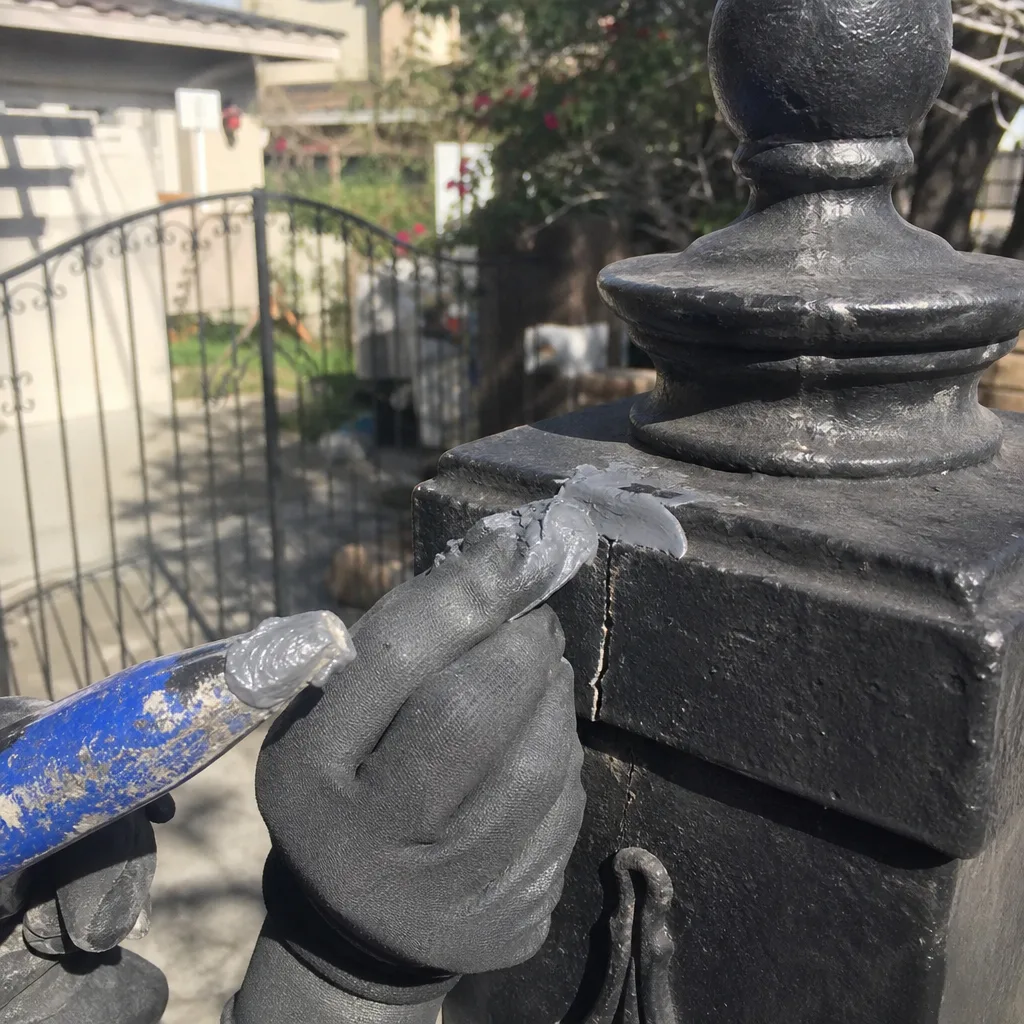
The tasks below are not on the DIY list because the failure mode when they’re done wrong is not “the gate stops working.” The failure mode is “the gate doesn’t stop when it should.” That’s the difference between an inconvenience and an injury.
Limit-Switch Calibration
The limit switch tells the operator when the gate has reached the end of its travel. Set it wrong, and the operator keeps pushing a gate past its mechanical stop, bending the gate, straining the motor, and eventually breaking a weld or a hinge. In a coastal environment like Huntington Beach, where gates are already dealing with salt corrosion and humidity-weakened hardware, an over-traveling gate fails faster than it would inland. A professional calibrates limit switches with a torque reference and photographs the final setting. A homeowner without that equipment is guessing, and guessing wrong on a gate that weighs hundreds of pounds is a structural risk, not just an operational one.
Operator Force Settings
Every gate operator since 2001 is governed by UL 325, the federal safety standard that limits the force a gate can apply to a person or object before it reverses. The force setting is not a “make it close harder” dial – it’s an entrapment safety parameter. Set the force too high, and the gate will keep pushing against a child, a pet, or a car that’s in the way. Set it too low, and the gate reverses on its own during normal opening. Professional technicians adjust force settings using a pressure gauge and a multi-point test, then document the readings. There is no safe way to set gate force by feel.
Loop Detector Sensitivity
If your gate opens automatically when a car approaches, there’s an inductive loop buried in the driveway. The loop detector’s sensitivity setting determines how reliably the gate senses a vehicle versus static noise from the environment. Huntington Beach’s concrete driveways with rebar reinforcement, combined with the occasional stray radio frequency from nearby marine and air traffic, make loop sensitivity a genuinely finicky calibration. Set it too sensitive, and the gate opens for bicycles, parked cars, or nothing at all. Set it too insensitive, and the gate ignores actual vehicles. A professional uses a signal-strength meter and records the setting.
Circuit Board Replacement
This is the task that inspired the opening of this guide. A gate operator’s circuit board carries a set of DIP switches or digital settings that configure every aspect of behavior: how long the gate stays open, whether it auto-closes, how it responds to the safety edge, how it communicates with the remote receiver. Replace the board without recording the old settings, and the new board starts from factory defaults. The gate might work, sort of, or it might do something unexpected – like closing on a car that’s half through. Every board we replace gets a before-photo, an after-photo, and a written record of every switch position and software parameter. That’s the difference between a repair and a re-engineering project.
The Documentation Standard That Should Apply to Every Repair
Here’s the core argument of this guide, and it applies whether you do the work yourself or hire a professional: every repair should leave a written record. See our Gate Repair Maintenance Checklist for Huntington Beach Homeowners for a practical starting point. The record should include the date, the part number or setting changed, the before and after values where applicable, and a note on why the change was made. That’s it. Four fields. If a repair doesn’t produce those four fields, it’s not a repair – it’s an experiment, and the next person who opens that control box becomes an archaeologist instead of a technician.
Why does this matter in Huntington Beach specifically? Because this is a market where homes turn over. A gate that works fine for the current owner becomes a mystery for the buyer, and a gate with no documentation is a gate that costs more to diagnose. We’ve seen homeowners pay $400 to have a technician trace a wiring modification that the previous owner made in an afternoon, because the previous owner didn’t write down that they moved the safety-edge wire from terminal 4 to terminal 6 to work around a corroded terminal. The documentation standard is not about professionalism for its own sake. It’s about making sure the next repair doesn’t require archaeology.
How to Document Your Own DIY Repair
- Photograph before you start. Get clear shots of the control board, the wiring junction, the hinge assembly – whatever you’re about to touch. Your phone camera is fine.
- Write the date and the product name of anything you apply or replace. “WD-40 Specialist Silicone, applied to hinge pins, March 15, 2026” is a complete record.
- Note the before and after for anything adjustable, even if you only nudged it. “Photo-eye alignment: adjusted slightly left, lens cleaned” is enough.
- Store the record where you’ll find it. A note in your phone, a printed sheet taped inside the control box, or an email to yourself. The control box is the best place because that’s where the next technician will look.
If you follow these four steps, your DIY repair has the same documentation value as a professional one. If you skip them, you’re the homeowner who saved $200 today and created a $600 problem for tomorrow – and tomorrow might be you, six months later, when the gate stops working and you can’t remember what you changed.
How Huntington Beach Conditions Change the DIY Calculation
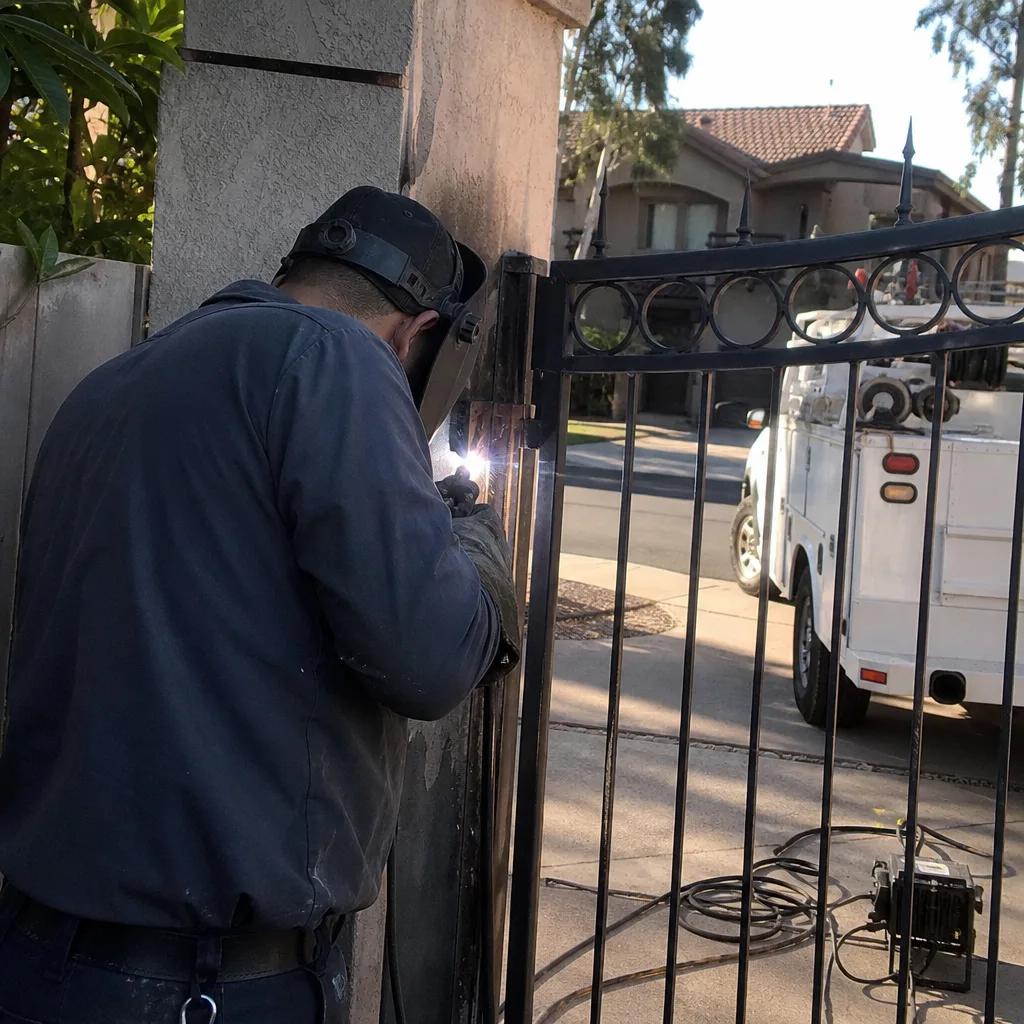
Huntington Beach is not a neutral environment for gate hardware. The combination of salt air, ocean moisture, and intense UV exposure means that gate components degrade faster here than they do a few miles inland, and the degradation is not always visible. Here’s what that means for the DIY decision.
Moisture Infiltration
Unsealed conduit connections let humidity into the wiring pathway, and that moisture condenses inside the control box. Over time, terminal screws corrode, and the corrosion creates resistance, and the resistance creates intermittent faults that are maddening to diagnose. A professional repair includes a seal check on every conduit entry and a record of what was found. A DIY repair that doesn’t check the conduit is likely to fail again within a season – not because the repair was wrong, but because the environment found a new way in.
UV Degradation
Components rated for outdoor use in most of the country are not necessarily rated for the UV intensity of coastal Southern California. A replacement part from a big-box store might carry an “outdoor” rating that assumes Denver or Chicago, not Surf City. The result: plastic components that embrittle and crack within eighteen months, wire insulation that flakes, and remote housings that literally crumble. Professional gate repair companies in Huntington Beach source UV-rated components specific to coastal exposure. A DIY part swap that saves money on the part may cost a second replacement within two years.
Salt Corrosion on Mounting Hardware
Gate hinge bolts, mounting brackets, and operator mounting plates all suffer salt corrosion at an accelerated rate in Huntington Beach. What looks like a solid bolt from the outside may be eaten halfway through from the inside. When we do Gate Repair in Huntington Beach, a visual and torque check on every mounting point is standard. A DIY repair that only addresses the visible problem may leave a rusted mounting bolt that fails a month later, taking the gate out of alignment or dropping the operator off its mount entirely.
How to Evaluate Whether a Professional’s Quote Is for a Documented Repair
Not all professional gate repair is equal, and the distinction matters as much as the DIY-vs-pro choice itself. A professional who gives you a verbal estimate and a handshake is offering something fundamentally different from a professional who gives you a written price and a documented record. Here’s how to tell the difference before you sign anything.
Question 1: Does the quote include a written scope?
A real professional gate repair quote names the specific component or adjustment being addressed, the part number where applicable, and the expected outcome. “Fix the gate” is not a scope. “Replace the FAAC limit switch, recalibrate travel, test entrapment force per UL 325, leave photo record” is a scope. If the quote doesn’t say what’s being done, the invoice won’t either, and you’ll be arguing about what “fixed” meant six weeks later.
Question 2: Does the company document what it found?
A parts-swap technician replaces the failed component and leaves. A documented-repair technician photographs the failed component in place, shows you what was wrong, photographs the new component installed, and hands you a record of what was changed and why. The difference matters because a parts swap without documentation means the next technician has to re-diagnose every problem from scratch. Documentation is the difference between a repair that accumulates knowledge and a repair that resets to zero.
Question 3: Is the price in writing before the work starts?
This is the single most important question to ask any gate repair company in Huntington Beach. A written price before work starts means the company is confident enough in its diagnosis to commit to a number. A verbal estimate that can change after “we get in there and see what’s really going on” means the company is not confident, or is planning to bill for its uncertainty. The Haven Standard at Vance Gate Repair mandates that the flat price is written and handed over before any work starts – Clause 1 (Have it in writing) – and that’s not a sales tactic. It’s a recognition that a homeowner shouldn’t bear the cost of a technician’s uncertainty.
What a Professional Gate Repair Actually Looks Like in Huntington Beach
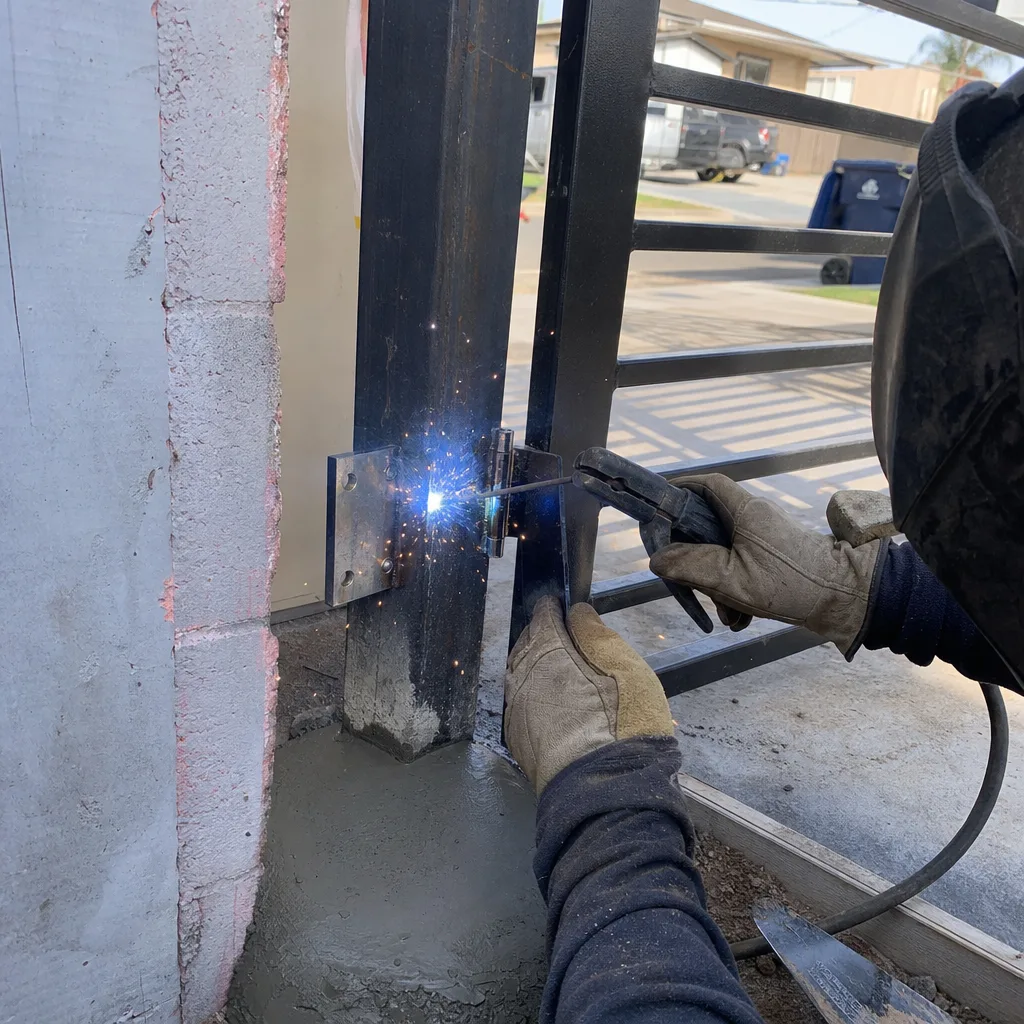
If this guide has made you lean toward professional repair, it’s worth knowing what a professional visit should include in this market. Not every gate company in Huntington Beach operates the same way, and knowing what to expect helps you distinguish a thorough repair from a quick parts swap.
The Visit, Step by Step
- Arrival and inspection. The technician opens the control box, checks the operator mounting, tests the gate’s travel from end to end, and verifies the safety edge and photo-eye are functioning. Every finding is photographed.
- Written diagnosis. Before any work begins, the technician explains what’s wrong, what the fix will be, and what it will cost – in writing. If the diagnosis requires opening a component that might hide additional damage, that’s disclosed up front.
- The repair. Parts are replaced or settings are adjusted, and every change is documented. The technician photographs the new part in place, the final setting values, and the wiring connections.
- Entrapment testing. The technician tests the gate’s reverse function under load, verifies the force setting against the UL 325 limit, and tests the photo-eye with an obstruction. These results are written down.
- The handoff. You receive a photo log of every finding and adjustment, a written record of the part number installed, and the flat price you agreed to before the work started. No surprises, no invoice that’s bigger than the quote.
Why the Photo Record Matters in Huntington Beach
Huntington Beach homes sell. When a new owner takes possession of a property with a gated driveway, they inherit the gate’s repair history whether or not any record exists. A home with a documented gate repair history is a home where the gate works reliably for the new owner – and that’s a selling point that goes beyond the gate itself. More importantly, when that new owner calls a gate company three years later because the gate is acting up, the photo record from the previous repair means the new technician can see exactly what was done, what parts were used, and what settings were recorded. That’s the difference between a $150 diagnostic visit and a $350 diagnostic investigation. The documentation you insist on today is a gift to your future self, or to whoever buys your home.
The DIY Repair Checklist for Homeowners Who Proceed
If you’ve read this far and confirmed that your repair task is on the DIY-appropriate list, here’s how to do it in a way that doesn’t become a liability. This is the same checklist we’d give a friend, and it applies specifically to Huntington Beach’s coastal environment.
- Confirm the gate is in manual mode. Before touching anything on the operator, release the manual disengage so the gate can’t move under power while you’re working. A powered gate moving unexpectedly is one of the most dangerous scenarios in residential repair.
- Photograph everything before you start. Control box open, wiring visible, hinge assembly, whatever. These photos are your documentation baseline.
- Use UV-rated, outdoor-specific products. Not all “outdoor” ratings are equal. Look for silicone-based lubricants and UV-stabilized replacement parts. In Huntington Beach, standard indoor products fail within months.
- Check the conduit seals while you’re in there. If you’re opening the control box for any reason, look at the conduit entries. Moisture intrusion is a slow, invisible killer of gate electronics in coastal environments. If the seal looks cracked or missing, that’s a professional call.
- Test the gate’s full cycle after any adjustment. Open, close, test the auto-close, test the safety edge by placing an object in the path. If the gate doesn’t reverse promptly, stop and call for professional calibration. A gate that doesn’t reverse is an entrapment hazard, not a minor annoyance.
- Write the record. Date, product used, what you changed, before and after values. Store it in the control box or wherever the next person will find it. This step is not optional. This is the entire point of doing it right.
Cost Comparison: DIY vs Professional Gate Repair in Huntington Beach
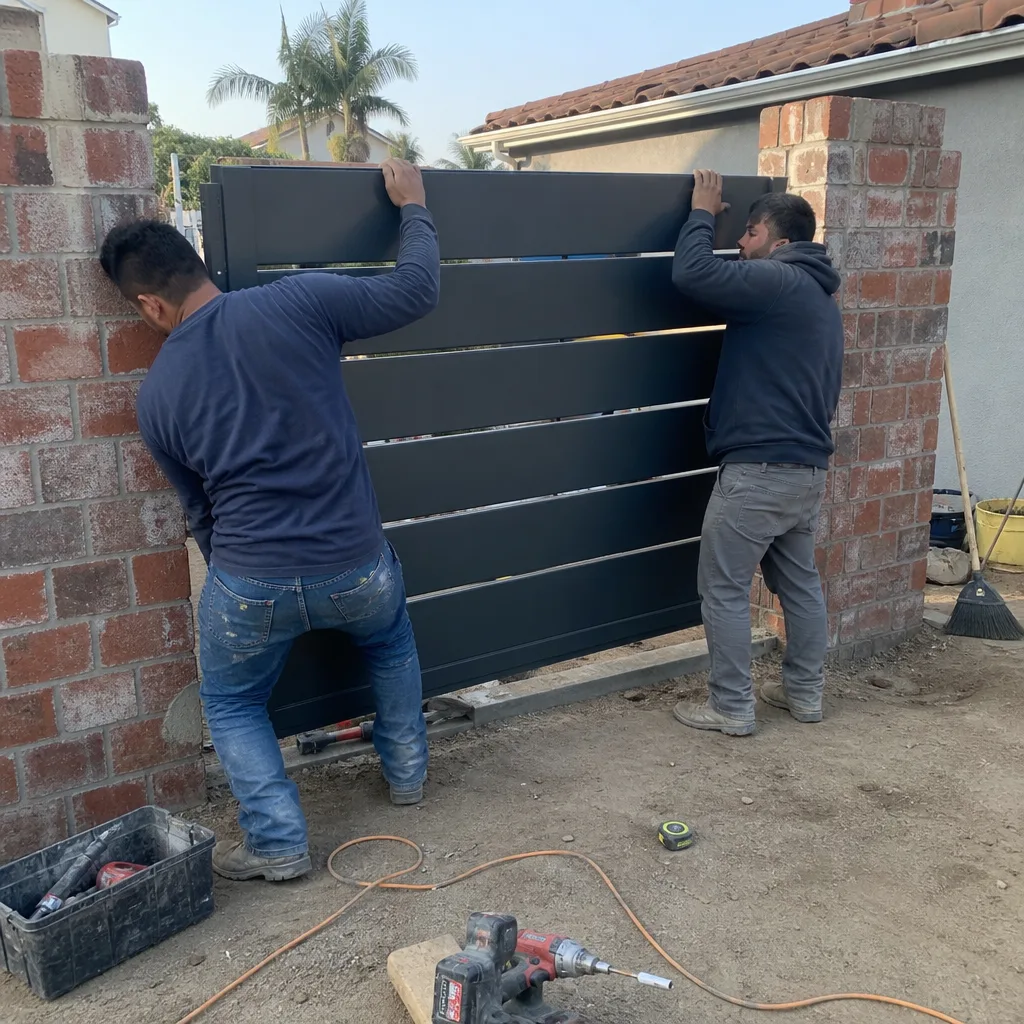
Here’s the honest math, and it’s more nuanced than “DIY is cheaper.” In Huntington Beach’s coastal environment, the real cost difference depends on whether the repair holds, and whether the documentation survives. For a detailed breakdown, see our Gate Repair Cost Breakdown: The Huntington Beach Homeowner’s Reference for 2026.
DIY-Friendly Tasks: The Math Works
- Hinge lubrication: $15-$30 for the right lubricant, 20 minutes of time, reapply every 4-6 months. Professional cost: typically $85-$125 for a lubrication visit. DIY wins on pure cost, and the documentation burden is minimal.
- Photocell cleaning: $0 if you have a soft cloth and warm water, 10 minutes. Professional cost: $75-$100 for a cleaning visit, though most pros include it in a broader maintenance call. DIY wins clearly.
- Remote resetting: $0 for the button sequence, 5 minutes. Professional cost: $50-$75 if a technician comes out just for this. DIY wins, but document which remote you programmed.
DIY-Risky Tasks: The Math Doesn’t Work
- Limit-switch calibration: DIY cost is “free” until the gate over-travels and bends. Professional cost: $120-$200, documented, with entrapment testing included. The risk-adjusted DIY cost includes a possible bent gate, a strained motor, or worse.
- Circuit board replacement: DIY part cost is $150-$400 depending on brand, plus the undocumented risk of wrong settings. Professional cost in Huntington Beach: $350-$700 including the board, programming, documentation, and entrapment verification. The DIY savings evaporate the moment you need a second diagnostic visit to fix what the first repair didn’t record.
- Operator force adjustment: DIY cost is zero, and the potential cost of getting it wrong is an entrapment injury. There’s no scenario where this is a rational DIY task for a residential homeowner, regardless of skill level. Professional cost: $100-$180, documented, tested, and compliant with UL 325.
The real cost comparison in Huntington Beach is not DIY dollars versus professional dollars. It’s undocumented dollars versus documented dollars. An undocumented repair – whether you did it yourself or hired a parts-swap company – carries a hidden cost that shows up the next time the gate fails and someone has to figure out what the last person did. The professional advantage at Gate Motor & Opener in Huntington Beach is not that we do the work better than a smart homeowner doing their best. It’s that we leave a record that makes the next repair – and the next owner’s repair – a known quantity.
Common Mistakes to Avoid
- Lubricating with WD-40. WD-40 is a water displacer, not a long-term lubricant. Applied to Huntington Beach gate hinges, it washes away within weeks and leaves the metal more exposed than before. Use a silicone-based outdoor lubricant and reapply on schedule.
- Skipping the manual release before working. A powered gate that activates while you’re working on it is a fast route to a serious injury. Always disengage the operator before touching the gate assembly, and verify the gate won’t move under gravity.
- Replacing a battery backup without testing the replacement. Installing a new battery and assuming it works is the same as not installing it. Test the new battery under load, time the run length, and write it down. In Huntington Beach’s fog season, an untested battery backup is a gamble.
- Adjusting force settings to fix a mechanical problem. If the gate is binding or failing to close, cranking up the force setting masks the underlying issue and creates an entrapment hazard. The door is binding for a reason – usually a misaligned hinge or a corroded roller – and the force setting is not the fix.
- Replacing a part with a “compatible” non-branded alternative. LiftMaster, FAAC, BFT, and Linear components are engineered to work together. A generic replacement may fit the mounting holes and fail electrically within a season, especially under Huntington Beach’s corrosion load. Match the brand and the part number.
- Not recording the repair. This is the most common mistake in residential gate repair, and it’s the one that costs the most over time. A repair without a record is not an asset – it’s a liability for whoever comes next, and that person might be you.
- Ignoring the conduit seals. In Huntington Beach, moisture intrusion through unsealed conduit is the leading cause of intermittent gate failures we encounter. A DIY repair that ignores the conduit is a repair that’s likely to be redone.
When to Call a Professional
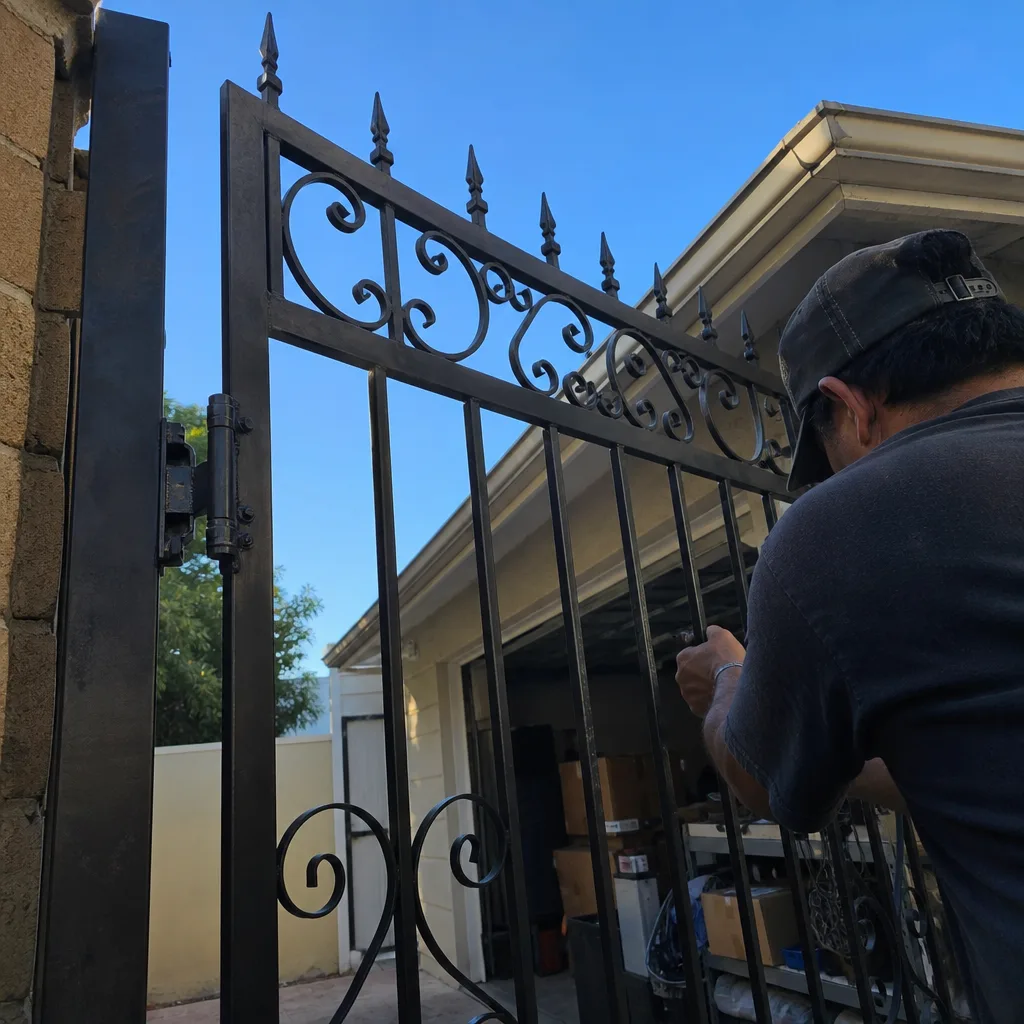
Call a professional if your gate is binding during travel, failing to reverse when obstructed, making grinding sounds from the operator, showing signs of water intrusion in the control box, or repeatedly blowing fuses. Call a professional if the photo-eye alignment is beyond a gentle nudge, if the gate over-travels its stops, or if you’ve replaced a part and the gate now behaves differently than before. Call a professional if you’re not sure what you’re looking at. And call a professional who will document what they find and give you a written price before any work starts – that’s the standard in this industry, and it’s what Gate Installation in Huntington Beach work demands. Vance Gate Repair Huntington Beach offers free estimates in Huntington Beach – call (657) 271-2877, and a live person answers, 24/7.
Frequently Asked Questions
Professional gate repair in Huntington Beach typically ranges from $85 for basic maintenance tasks like lubrication and photocell cleaning to $350-$700 for control board replacement or motor service, depending on the brand and the extent of the work. Every Vance Gate Repair quote is written and handed over before any work starts – call (657) 271-2877 for a free estimate on your specific issue.
No. A grinding sound from a gate operator indicates gear wear or mechanical failure inside the operator housing, and opening that housing to inspect the gears exposes you to high-voltage wiring and stored energy. This is a professional repair, and in Huntington Beach’s coastal environment, the corrosion that accelerates gear wear is often hidden inside the housing. Call (657) 271-2877, and we’ll diagnose it with documentation.
In our experience, it’s the undocumented circuit board replacement. Homeowners replace the board, skip recording the DIP switch settings, and the gate works unpredictably afterward – sometimes closing on a car that’s half through, sometimes not responding to remotes. The board replacement itself might be competent; it’s the missing documentation that creates the problem. If you attempt this yourself, photograph every setting before removing anything.
Yes. Salt air, ocean moisture, and intense UV combine to corrode terminals, degrade plastic components, and accelerate rust on mounting hardware faster than inland Southern California environments. Conduit seals fail within a few years, and moisture intrudes into control boxes, causing intermittent faults. This is why documentation matters more here – repairs in Huntington Beach don’t just fail; they fail in ways that look like the original problem but aren’t.
A documented repair means the technician photographs the problem before the fix, records the settings and part numbers changed, photographs the new installation, and hands you a written record of everything. You should care because the next time the gate fails – or the next time a buyer asks about the gate – that record is the difference between a $150 diagnostic visit and a $350 investigative excavation. Call (657) 271-2877 to discuss your gate, and we’ll tell you what documentation applies to your situation.
Ask three questions: Does the quote name the specific component and adjustment being addressed? Will the company photograph what it finds and hand you a record of what was changed? Is the price in writing before the work starts? If the answer to any of those is no, you’re likely looking at a parts swap with no documentation. At Vance Gate Repair, the written price and the photo record are policy, not a premium service – call (657) 271-2877 for a free estimate.
No, for lubrication alone, DIY is genuinely fine and cost-effective. A $15 silicone lubricant and twenty minutes of your time four times a year keeps hinges and rollers healthy. The professional value is in the inspection that comes with a maintenance visit – checking conduit seals, torque on mounting bolts, and operator settings – which we include in every service call at no extra charge. Call (657) 271-2877 if you want a full inspection alongside the lubrication.
The Bottom Line
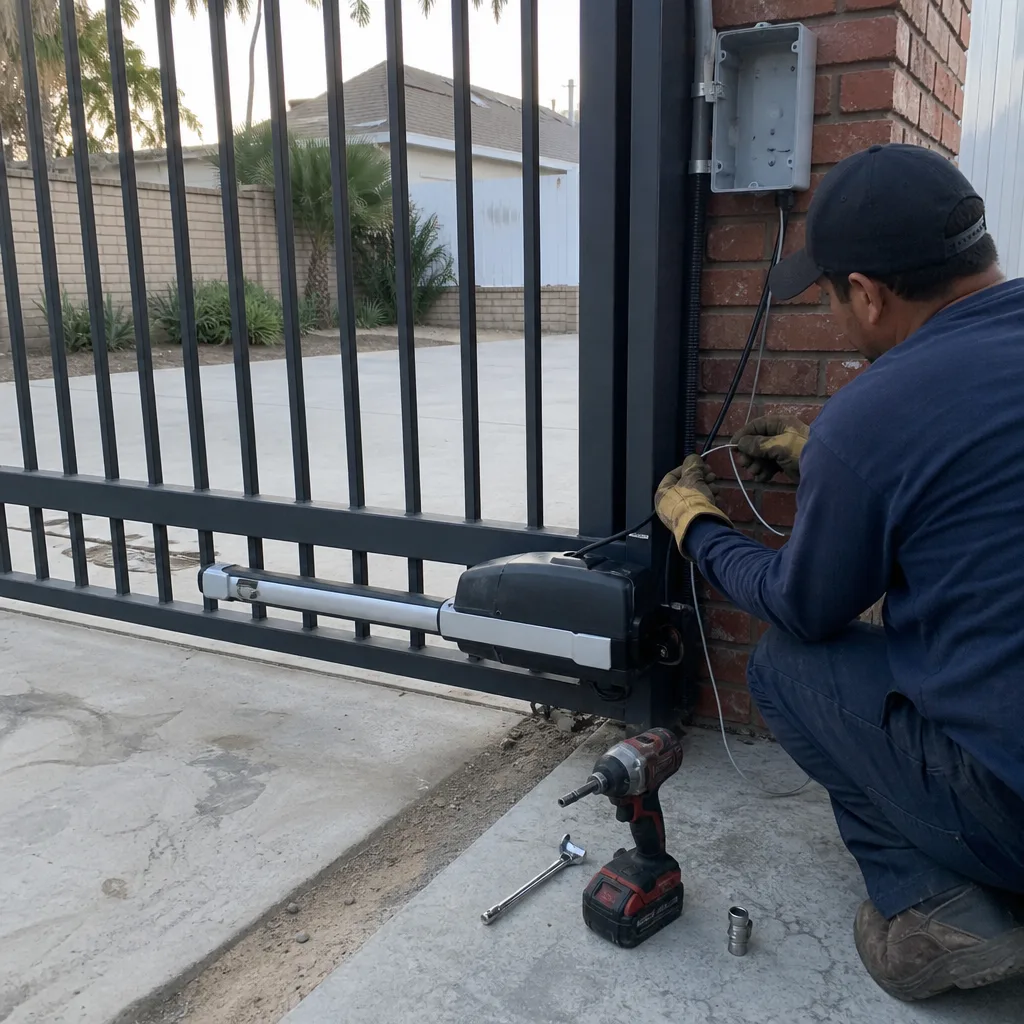
The DIY-vs-professional decision for gate repair in Huntington Beach is not about whether you’re smart enough or handy enough to do the work. It’s about whether the work you do will leave behind a record that makes the next repair – and the next owner’s repair – a known quantity instead of a mystery. For five low-risk tasks, DIY is genuinely appropriate, and the documentation is simple enough that any homeowner can do it. For everything else, the risk is not that you’ll do the work wrong – it’s that you’ll do the work right but undocumented, and the next failure will cost more to diagnose than the original repair would have cost to do properly. In a coastal market where gates fail faster and homes turn over frequently, the documented repair is the only repair that holds its value. That’s the standard at Vance Gate Repair Huntington Beach, and it’s the standard every homeowner in this market should expect. For more guides & resources on gate maintenance and repair decisions, visit our blog.ket should demand.
Written by Adrian Vance, Owner at Vance Gate Repair Huntington Beach, serving Huntington Beach since 2014.