
Last updated September 20, 2026
Free on-site gate assessment - hinges, posts, and your LiftMaster or Nice gate operator checked before anything is quoted
The assessment is free and the quote is the invoice.
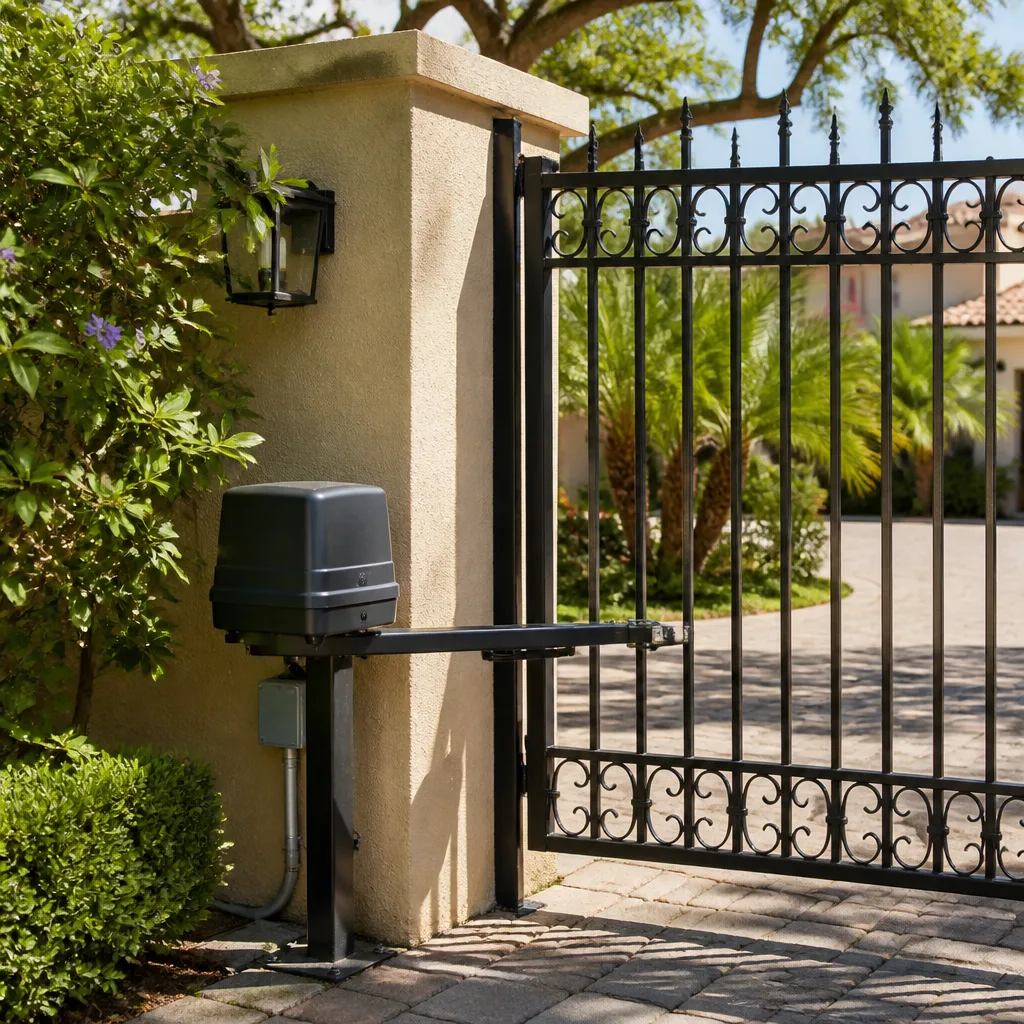
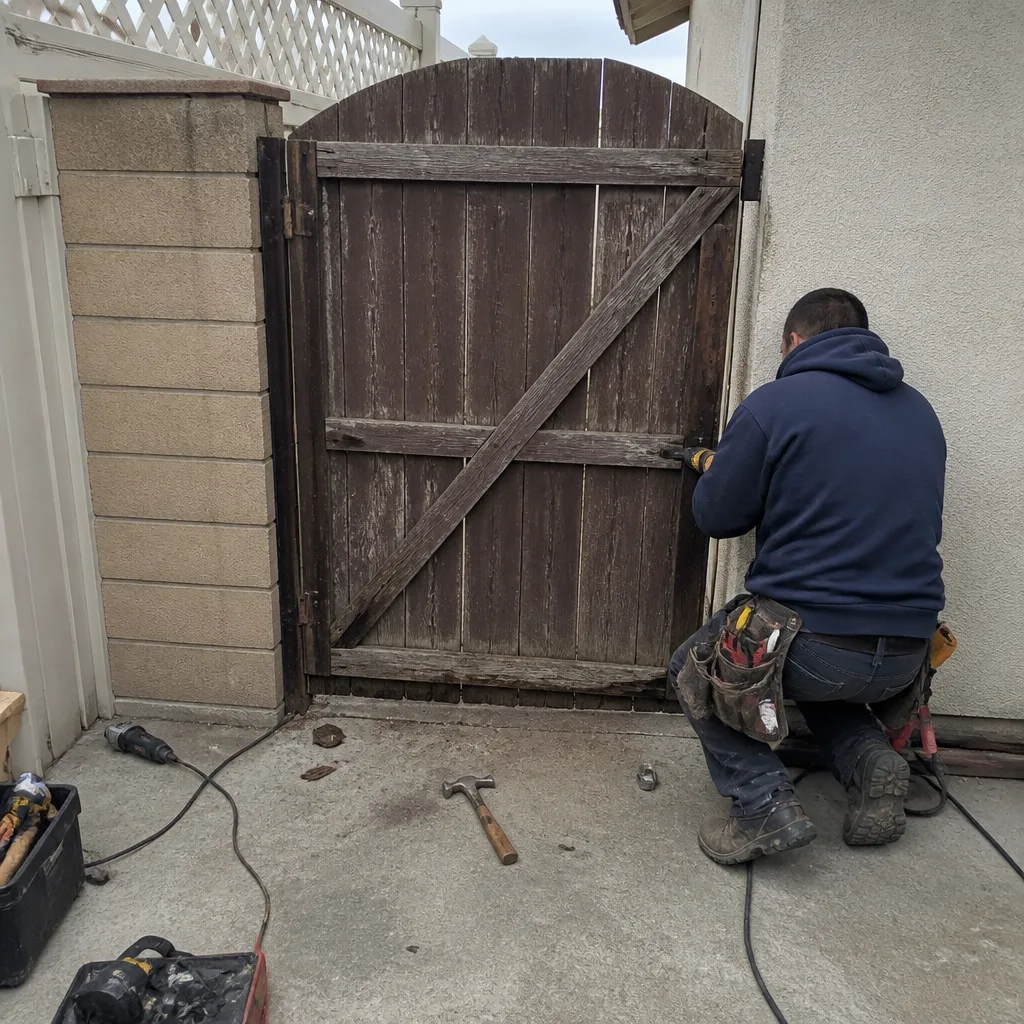 Before
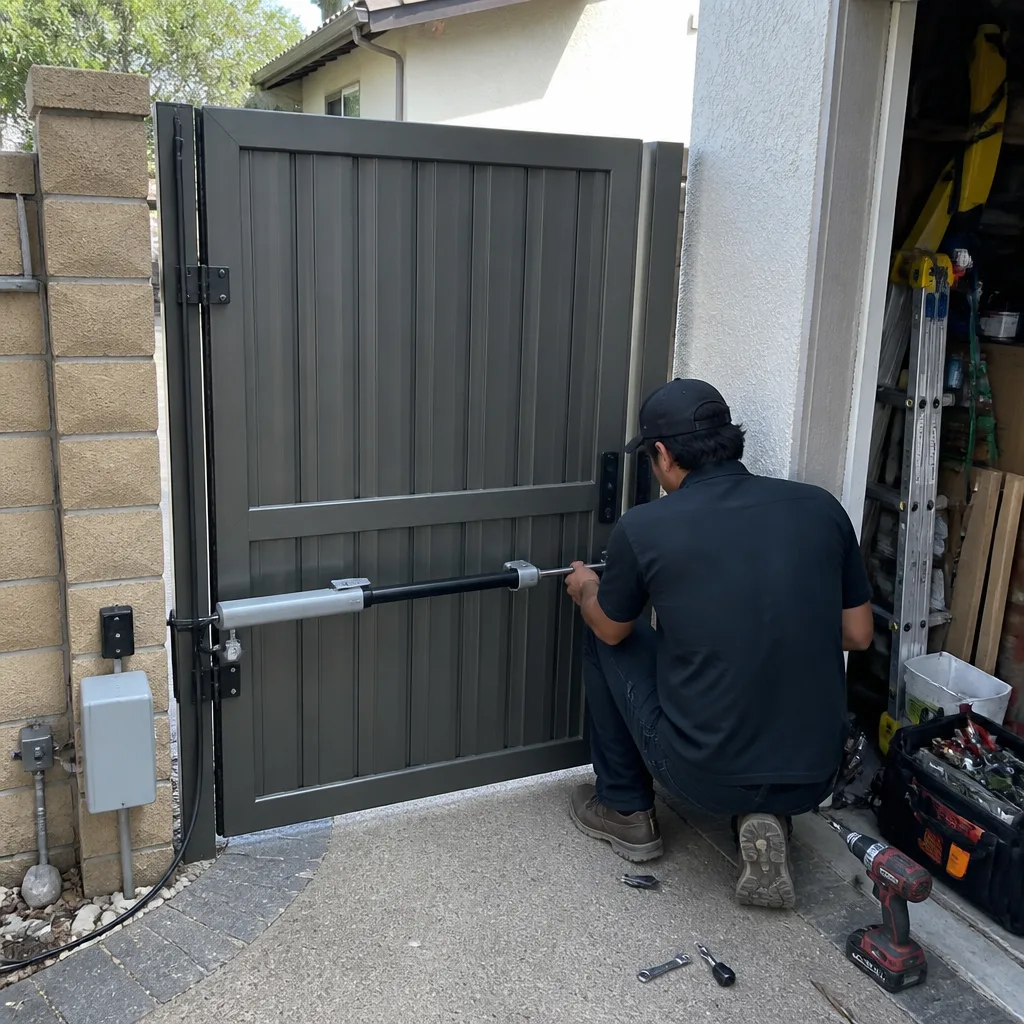 After
After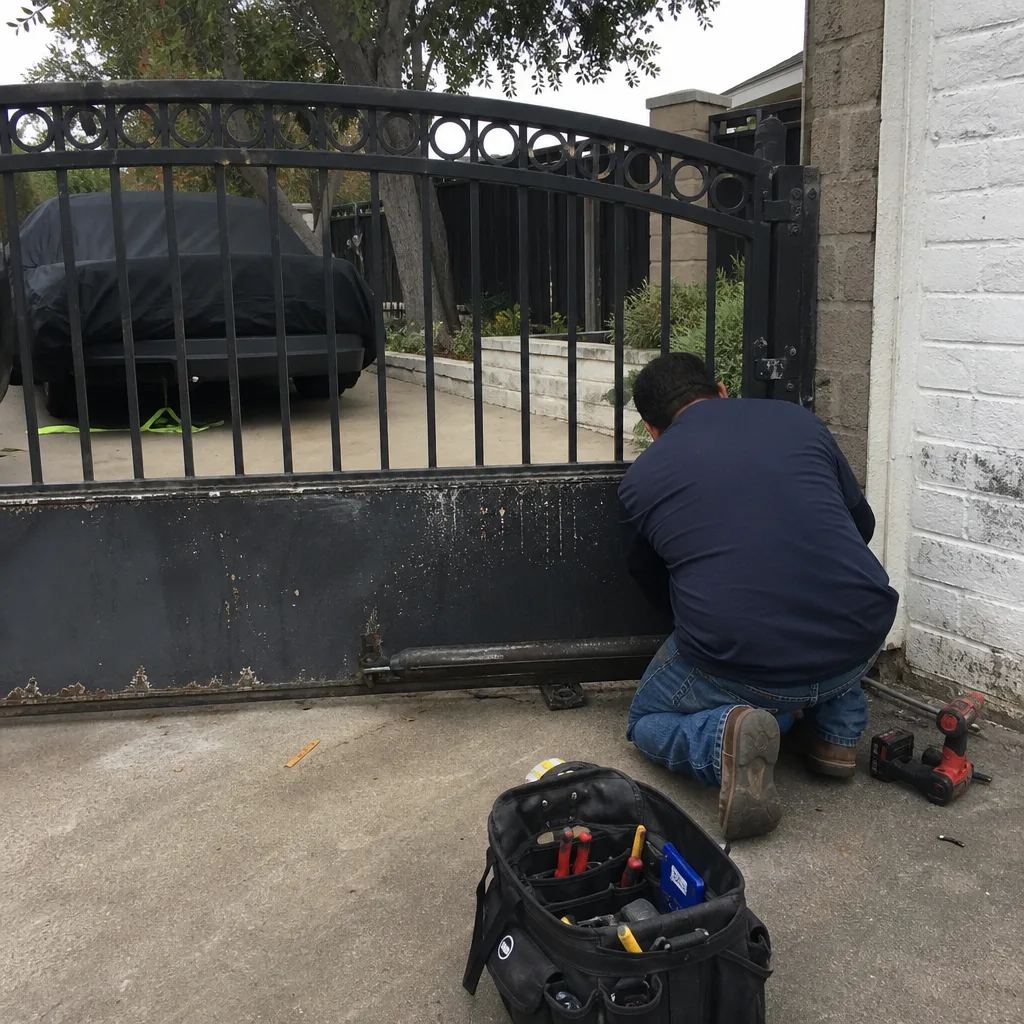 Before
 After
After Before
 After
AfterThe Complete Guide to Gate Repair in Huntington Beach
Most gate repair guides read like they were written for a driveway in Ohio. They talk about motors and hinges and circuit boards as if the air around them doesn’t matter. But in Huntington Beach, the air is the problem. Salt fog off the Pacific settles into every terminal strip, every hinge pin, every exposed limit-switch wire. A gate that fails once from a corroded limit switch will fail again in six months if the technician replaces the switch without photographing and sealing the conduit entry point that let moisture in, and in Huntington Beach’s coastal air, that second failure is nearly guaranteed.
This guide maps every repair category to the physical evidence a technician should document before quoting, so you know exactly what a thorough job looks like versus a hasty one. You’ll learn why a gate fails, what a complete diagnostic actually involves, what repairs cost in this market (see our Gate Repair Cost Breakdown: The Huntington Beach Homeowner’s Reference for 2026), and what separates a repair that lasts from one that just buys you a season.
If you’re dealing with a gate that won’t open, grinds when it moves, or slams shut on its own, start here. This is the guide we wish every customer had before the first technician showed up, and you can find more guides & resources on our blog.
Quick Answer
Gate repair in Huntington Beach typically costs $185 to $650 for most mechanical and electrical fixes, with motor replacements running $700 to $1,500 depending on brand and hardware condition. The single most important factor in whether a repair lasts is whether the technician documents the root cause, not just the part that failed. In coastal air, undocumented moisture intrusion means the same corrosion returns within a season.
Key Takeaways
- Salt air is the primary repair driver in Huntington Beach. It corrodes control board terminals, hinge hardware, and motor brushes faster than inland California by a factor of roughly two to three.
- Sandy grit infiltrates track systems. Slide gates within two miles of the beach accumulate enough sand in their rollers to double motor amperage draw and trip overload circuits.
- A written quote before work starts is the single best predictor of a fair repair experience. If a technician won’t commit a price to paper before touching tools, that’s a decision, not a limitation.
- Documentation protects the homeowner, not just the contractor. A photographed record of limit-switch positions, wiring conditions, and part numbers means the next technician doesn’t have to re-diagnose from zero.
- Most gate failures are repairable. A motor that trips its breaker is often a force-adjustment or photo-eye issue, not a replacement scenario. Beware any technician who skips to replacement without measuring anything.
 Before
 After
AfterTable of Contents
- How Coastal Air Changes Gate Repair
- Gate Types and Their Failure Patterns
- The Complete Pre-Repair Diagnostic
- Common Gate Problems and What They Cost
- Why Documentation Matters More Than You Think
- Repair vs. Replace: How to Know
- HOA and Access Control Considerations
- Common Mistakes to Avoid
- When to Call a Professional
- Frequently Asked Questions
How Coastal Air Changes Gate Repair
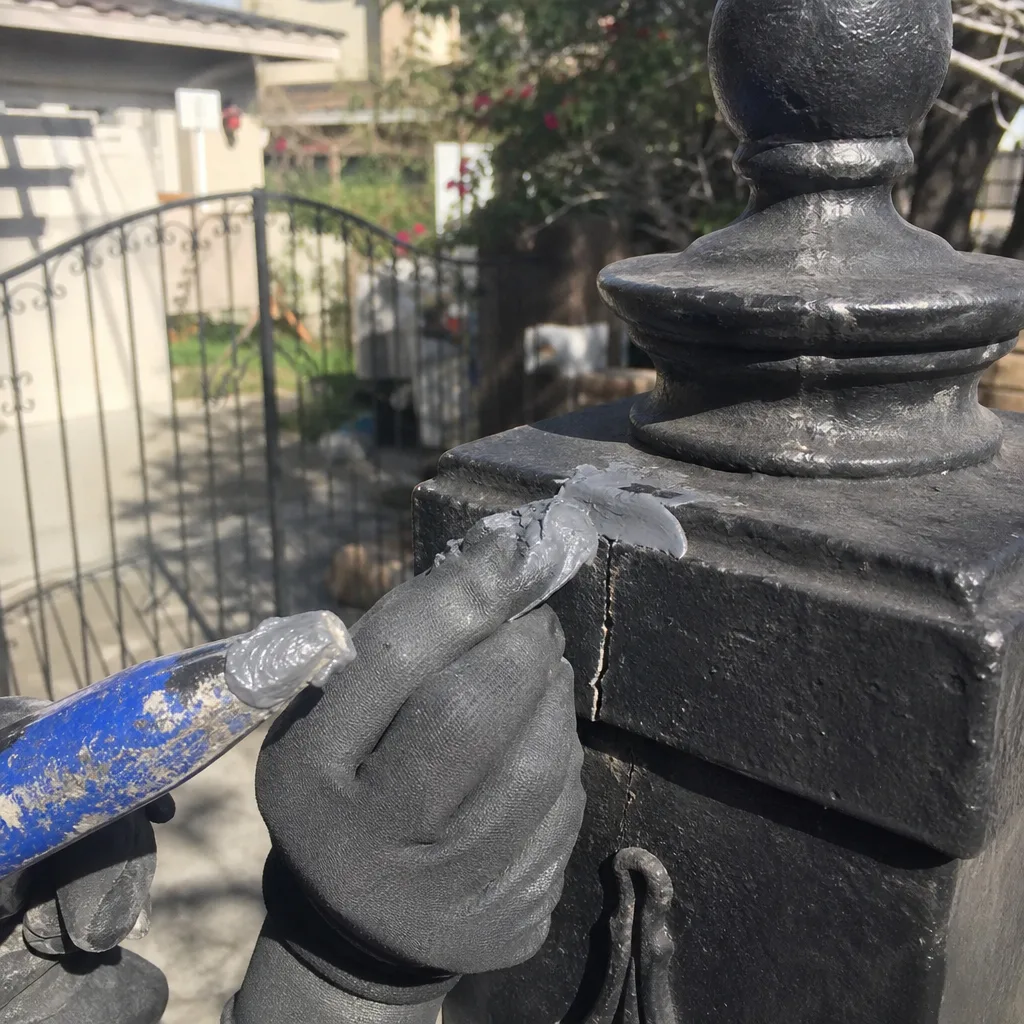
Here’s a fact that changes how you should think about gate repair in Huntington Beach: the same gate hardware that lasts twelve years in Riverside needs serious attention at year six in Surf City. Salt fog is not a metaphor. It’s a physical layer of sodium chloride that deposits on every exposed metal surface every single day, and it works continuously even when the gate isn’t moving.
The failure points fall into three predictable categories:
- Motor brushes and commutator surfaces. Salt accelerates pitting on the copper contact points inside DC gate motors. We’ve opened motors in Huntington Beach where the brushes looked like they’d been sanded with salt, and the motor was only four years old. An inland customer with the same motor would have gotten eight or nine years out of it.
- Control board terminals. The screw terminals where limit-switch wires, photo-eye wires, and power leads connect to the control board are the most common corrosion points we document. Salt creeps along the wire strands and attacks the copper at the connection point. The board looks fine from the front. Behind the terminal block, the copper is green and the resistance has tripled.
- Hinge hardware and gate structure. Steel hinges on swing gates rust from the inside out in coastal air. The pivot pin starts binding, the opener motor works harder to move the gate, and the force-adjustment circuit eventually trips because the gate now needs three times the force it did when new.
There’s a second factor specific to Huntington Beach: sand. Properties within a mile or two of Pacific Coast Highway, especially in the Seacliff, Sunset Beach, and Bolsa Chica areas, accumulate fine silica grit in slide-gate track rollers. This grit acts like sandpaper on the nylon wheels, wears them into a flattened oval, and forces the motor to pull harder. The overload sensor reads that extra resistance as an obstruction and reverses the gate halfway through its travel. That’s the “gate opens six inches and stops” behavior you see so often in coastal neighborhoods.
A technician who works in Huntington Beach should know all of this without you explaining it. If you have to educate the technician about salt corrosion, you’ve hired the wrong person. For more on how we approach repair work specifically in this market, see our Gate Repair in Huntington Beach service page.
Gate Types and Their Failure Patterns
Not all gates fail the same way. The three gate types common to Huntington Beach driveways and communities each have a signature failure profile, and knowing yours narrows the diagnosis before the technician even opens the control box.
Swing Gates
Swing gates dominate residential driveways in Huntington Beach’s tract-home neighborhoods and the older sections of downtown. These are the dual or single leaf gates that pivot on hinges and arc open.
Their dominant failure pattern is mechanical: hinge wear, actuator arm fatigue, and gate leaf sag. The opener motor on a swing gate uses an articulated arm or a linear actuator to push and pull the leaf. When the hinge starts to bind from corrosion or the leaf sags even a quarter inch, the motor’s amperage draw climbs. The force-adjustment circuit, if it’s set correctly, will detect the extra load and reverse the gate or refuse to open it.
The evidence a thorough technician documents: hinge pin wear measured against the hinge body, distance from gate leaf to the post at rest, actuator stroke compared to factory spec, and motor amperage under load. If any of these numbers are missing from the repair record, the diagnosis is incomplete.
Slide Gates
Slide gates are more common on larger lots, custom homes, and in the gated enclaves around Edwards Hill and Huntington Harbour. A slide gate rides on steel rollers along a track or cantilevered rail.
In Huntington Beach, the failure pattern is grit-driven. Sand works into the roller bearings, wears the nylon or steel wheels, and eventually the gate starts binding mid-travel. The symptom is almost always intermittent: the gate opens fully at 6 a.m. when it’s cool and moist, then fails at 2 p.m. when the track expands in the sun and the binding tightens. Intermittent failures are the hardest to diagnose, and they’re where documentation matters most. A technician who reads the motor’s amperage draw while the gate moves through its full travel can often catch the binding point before it becomes a full stall.
Barrier Arm Gates
Barrier arm gates appear at HOA entries, condo parking structures, and light commercial lots. Their failure profile is impact damage and improper force settings. A car hits the arm, the arm snaps or bends, and the operator’s internal gears or spring mechanism takes a hit even if the arm itself looks fine. In coastal air, the spring housing on some barrier arm models also corrodes and seizes.
The repair pattern for a barrier arm is different from residential gate work: the technician should check arm balance, spring tension, gear lash, and the operator’s obstacle-detection response time. A barrier arm that doesn’t reverse fast enough after hitting an obstacle is a safety liability, not just a convenience problem.
The Complete Pre-Repair Diagnostic
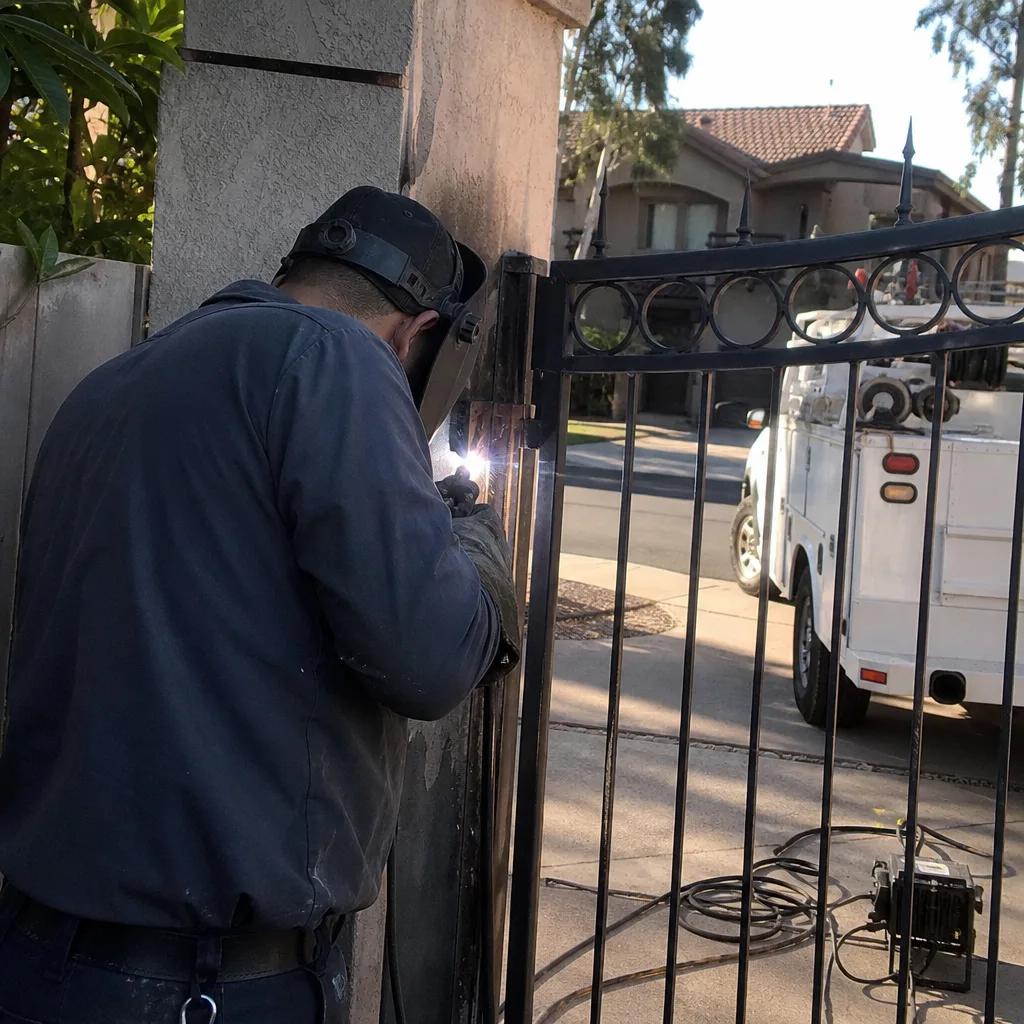
There’s a gate in front of you that won’t open. Before anyone should touch a tool or hand you a quote, a competent technician performs a sequence of measurements and observations. Here’s what that sequence looks like when it’s done right, in order.
- Mechanical inspection with the operator disengaged. The technician manually opens and closes the gate by hand, feeling for binding, listening for grinding, and measuring how much force the gate requires to move. On a swing gate, they check hinge play and gate leaf sag against the post. On a slide gate, they roll the gate by hand along the full track length and mark any spots where resistance increases.
- Limit-switch reading. The limit switch tells the motor where to stop. The technician reads its current setting, compares it to the correct travel range, and notes the discrepancy. A gate that slams at the end of travel or stops six inches short of the post usually has a limit-switch problem, which is why the reading matters: it’s objective evidence, not a guess.
- Force-adjustment test. The operator’s force setting determines how hard the motor pushes before deciding something is blocking it. A technician should test this with the gate detached from the motor, then attached, and compare the amperage draw each way. A swing gate drawing 6 amps during normal travel when the factory spec is 3.2 amps needs attention even if it’s still technically working.
- Wiring continuity and terminal inspection. Every connection point gets checked for corrosion, looseness, or heat damage. In Huntington Beach, this step matters more than in most markets because of the corrosion rate. A terminal that reads 0.2 ohms today may read 3 ohms by August.
- Photo-eye and safety-edge check. The infrared beam and the contact edge (if present) are tested for alignment and response time. A misaligned photo-eye is the single most common cause of a gate that won’t close, and it’s a two-minute fix when it’s caught early.
- Documented baseline. Every reading gets written down. Amperage, limit positions, force settings, terminal conditions, photo-eye alignment, hinge wear. This is the record that protects you when the next technician arrives two years later and doesn’t have to start from zero.
A diagnostic like this takes thirty to forty-five minutes on a residential gate. If a technician quotes a price five minutes after arriving and before opening the control box, you’re not getting a diagnostic. You’re getting a guess.
Common Gate Problems and What They Cost
Here’s what we see most often in Huntington Beach, and what each repair pattern should cost. These are local market ranges for this area, not national averages. Prices include labor and standard parts.
| Problem | Typical Repair Cost | What’s Involved |
|---|---|---|
| Misaligned or failed photo-eye | $125-$250 | Realignment, wiring check, and replacement if the sensor is corroded |
| Corroded limit switch | $150-$300 | Switch replacement, wire termination renewal, and conduit sealing to prevent recurrence |
| Worn or seized gate hinges | $200-$450 per hinge | Pin replacement or full hinge replacement depending on corrosion depth |
| Force-adjustment reset and motor tune-up | $180-$350 | Amperage testing, limit reset, force adjustment, terminal cleaning |
| Control board replacement | $350-$750 | Board swap, all terminal connections renewed, photo-eye and limit switch re-verified |
| Swing-gate motor or actuator replacement | $700-$1,500 | Motor or actuator swap, bracket inspection, force re-calibration, documentation |
| Slide-gate roller replacement | $300-$600 | New rollers, track cleaning, alignment, motor draw re-test |
These are the prices you should expect in Huntington Beach for most residential gates. If a swing-gate motor replacement is quoted at $2,800, ask to see the specific hardware that justifies the number. That’s not an indicator of honesty on its own, but it’s high enough that a written breakdown is the only way to verify it.
Every price on our jobs is written and handed over before work starts. That’s Haven Standard Clause 1, and it applies to every visit, every time. You can read more about how we price motor work specifically on our Gate Motor & Opener in Huntington Beach page.
Why Documentation Matters More Than You Think
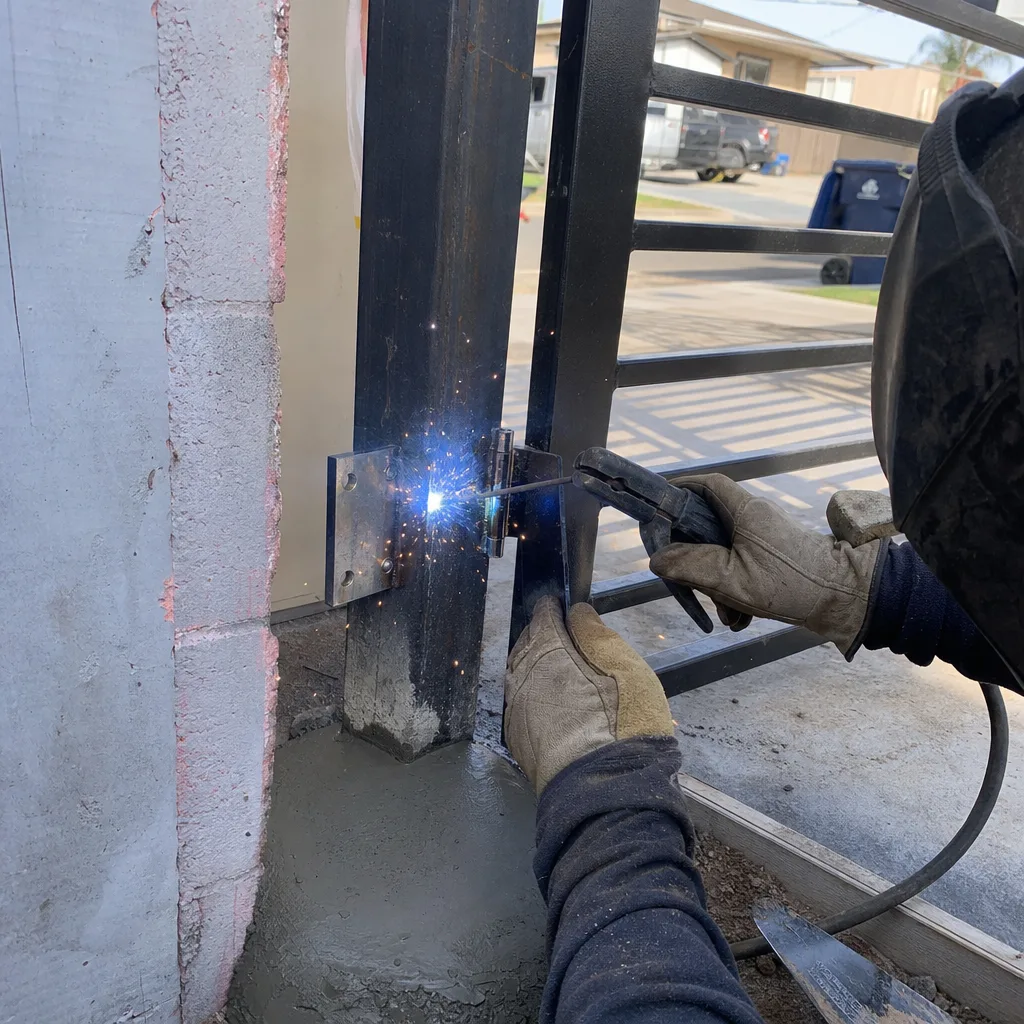
Most homeowners never ask what paperwork they’ll get after a repair. That’s a mistake, and here’s why.
When a technician leaves your property without a written record of what was found, what was adjusted, and what was installed, the next repair begins from zero. The new technician doesn’t know that the limit switch was replaced in 2024 for corrosion. They don’t know that the force setting was calibrated at 4.3 amps on a specific motor. They don’t know which photo-eye brand was installed and whether the wiring is original or replaced. So they re-diagnose everything, which adds labor time to your invoice, and sometimes they replace a part that was already replaced two years ago because there’s no record saying it’s new.
The record protects you in another way too. If a repair fails within warranty, documentation proves what was actually done. A technician who says “I replaced the hinge pin” but left no photo and no part number has given you nothing you can hold onto if the hinge fails again in three months.
We carry a commercial documentation habit into every residential gate job. It came from Adrian Vance’s access-control work starting in 2014, where wiring diagrams and photo logs were standard practice because a commercial property owner can’t afford a gate that mysteriously fails every few months. On every visit, we leave a photographed record of what we found, what we set, and what we installed. Limit-switch positions. Force readings. Terminal conditions before and after. Part numbers. It’s filed in the job record and left with you.
That’s Clause 4 of The Haven Standard: evidence on every job. If a company won’t commit to documentation, ask yourself why.
Repair vs. Replace: How to Know
The industry’s open secret is that replacement always earns more than repair. A motor that could be rebuilt for $300 becomes a $1,200 replacement because that’s the path of least resistance. We don’t steer that way, and here’s the framework we use to decide whether a gate deserves repair or replacement.
Repair is the right call when:
- The gate structure is sound and the failure is isolated to one component: switch, sensor, hinge, or bracket.
- The motor or operator is less than 8 years old and the failure is electrical rather than mechanical.
- The repair cost is under 40% of a comparable replacement, and the gate still passes a manual movement test without unusual binding.
- The gate is a custom size or shape that would be expensive to reproduce.
Replacement is the honest recommendation when:
- The gate structure itself is compromised: rust-through on the frame, sag beyond what hinges can correct, or a slide track so worn that new rollers won’t seat properly.
- The motor has both winding failure and gearbox wear, and the motor is over 12 years old. You’d spend nearly the cost of new to fix both systems.
- The repair requires three or more major components simultaneously, and the total crosses 60% of replacement cost.
In Huntington Beach, coastal corrosion accelerates the time to replacement on steel gate frames. A steel swing gate that lives within walking distance of the beach may need frame repair or replacement at year eight, while the same gate in Fountain Valley would go fifteen years. That’s not poor materials. It’s the environment. For situations where a new gate is genuinely the right answer, see our Gate Installation in Huntington Beach page.
HOA and Access Control Considerations
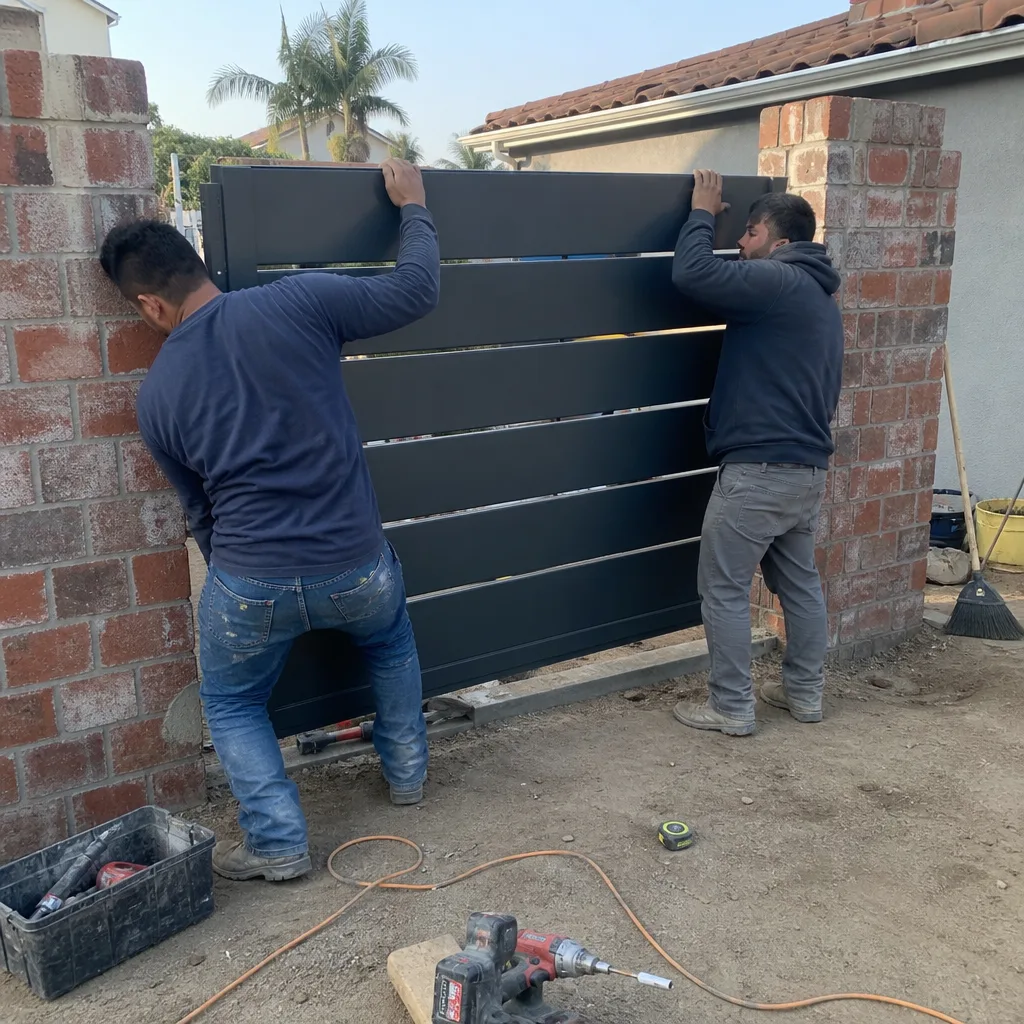
A substantial portion of gate work in Huntington Beach involves homeowner associations. The gated communities around Huntington Harbour, the condo complexes off Warner, and the newer developments along the northern edge of the city all have shared gate infrastructure, and the repair calculus is different there.
The primary difference is liability. A residential driveway gate that fails just annoys the homeowner. A community entry gate that fails blocks emergency access, traps residents, and generates phone calls to the management company. HOA gate systems are therefore maintained more aggressively, and the access control layer adds complexity that single-family gates don’t have.
Access control systems in Huntington Beach communities often include telephone entry panels, RFID readers, keypads, and sometimes video intercom integration. When the gate itself needs repair, the technician has to work around these systems without disabling them permanently. That means the diagnostic includes checking that the access-control relay is correctly wired to the gate operator’s open input, and that the operator’s obstacle-reversal function hasn’t been disabled by a previous technician trying to stop “nuisance” reversals.
A note on safety: gate operators store significant mechanical force. A swing gate moving at full speed can seriously injure a person or animal if the obstacle-detection system has been bypassed or set incorrectly. If you’re on an HOA board or managing a community property, the force-adjustment and photo-eye testing should be part of every service visit, not an optional add-on. The technician should show you the readings.
We service Vance Gate Repair Huntington Beach home area communities and bring the same written-quote and photographic-documentation standard to HOA work as to single-family jobs. The difference is scale, not rigor.
Common Mistakes to Avoid
- Replacing the part without finding the moisture path. This is the single most common failure pattern we see in Huntington Beach. A technician replaces a corroded limit switch but doesn’t seal the conduit entry that let salt air in, and the new switch dies the same way six months later. Ask specifically whether the technician sealed and photographed the entry point.
- Skipping the force-adjustment test. If the technician doesn’t check amp draw under load, they can’t distinguish a gate that needs a new motor from one that just needs a force setting adjusted. A $1,200 motor replacement sometimes fixes a $200 calibration problem.
- Trusting a verbal estimate. A price spoken out loud has no legal force and no detail. Haven Standard Clause 1 exists precisely because nothing about a verbal quote protects the homeowner. Always get it in writing before work starts.
- Ignoring intermittent failures. The gate that only fails on hot afternoons or after rain is telling you something specific. Don’t wait for the gate to fail permanently. The early-stage repair is almost always cheaper, and the diagnostic evidence is fresher.
- Replacing a gate opener without checking the gate itself. The gate structure and the operator are a system. A motor that burned out because the hinges seized will burn out again if the hinges aren’t replaced. The technician should check the whole mechanical path before quoting a motor swap.
- Accepting a repair with no written record. Without documentation, you surrender your ability to verify the work or claim a warranty later. Every professional gate repair should leave a paper or digital trail.
- Hiring on price alone without asking about the diagnostic process. The cheapest quote often skips the diagnostic entirely and just swaps a part. That’s not cheaper in the long run.
When to Call a Professional
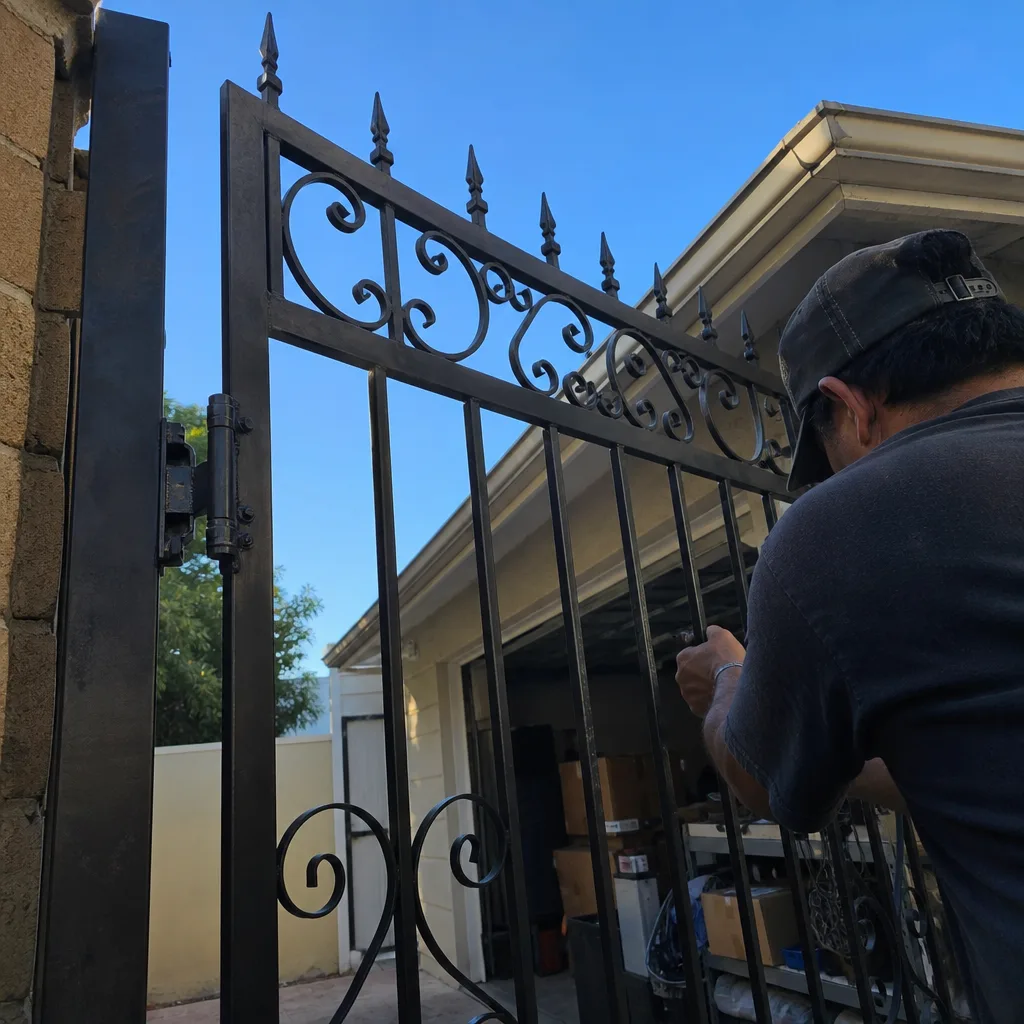
Call a gate professional when the gate stops responding consistently, when it makes grinding or clicking sounds that it didn’t make before, when it reverses unexpectedly during travel, or when you see visible corrosion or rust at the hinges, track, or control box. These are not problems that improve with time, and in Huntington Beach’s coastal air, the deterioration rate is faster than most homeowners expect.
Also call before you attempt any DIY work that involves the motor, the wiring, or the springs. Gate operators store mechanical energy and can cause serious injury if the springs or force settings are mishandled. The diagnostic steps described in this guide are for evaluating a technician’s work, not for doing the work yourself-read our DIY vs Professional Gate Repair: The Huntington Beach Homeowner’s Decision Guide to understand why.
Vance Gate Repair Huntington Beach offers free estimates in Huntington Beach. Call (657) 271-2877 and a live person answers, any hour of the day or night.
Frequently Asked Questions
Gate repair in Huntington Beach typically ranges from $185 to $650 for most mechanical and electrical fixes, with motor or actuator replacements running $700 to $1,500 depending on brand and hardware condition. The final price depends on what the diagnostic reveals: a misaligned photo-eye costs under $200 to fix, while a corroded control board replacement runs $350 to $750. Every job we quote includes a written price before work starts, and there’s no charge for the estimate. Call (657) 271-2877 for an exact quote.
Yes. We keep repair crews available for same-day service in Huntington Beach, and a live person answers the phone 24/7, so you’re never leaving a voicemail and waiting for a callback. If your gate is stuck open or stuck closed and you need it addressed today, call (657) 271-2877 and we’ll get a named technician to your property same day in most cases.
Salt air deposits sodium chloride directly onto exposed metal surfaces, which accelerates oxidation on control board terminals, motor brushes, hinge pins, and wiring connections. Huntington Beach’s proximity to the Pacific means this corrosion happens continuously, even when the gate isn’t operating. The result is that coastal gates need more frequent electrical maintenance and more aggressive sealing at connection points than inland gates do.
Repair is usually the right call when the gate structure is sound and the failure is isolated to one component like a switch, sensor, or hinge, and the repair cost stays under 40% of replacement. Replacement makes sense when the frame itself is rusted through, the motor has multiple failed systems, or the repair total exceeds 60% of new gate cost. A proper diagnostic will tell you which path is honest, and the evidence should be documented either way.
A photo-eye is the infrared beam that runs across the gate opening and tells the operator to stop and reverse if something crosses the path. In Huntington Beach, salt corrosion on the photo-eye’s wiring terminals or physical misalignment from wind and fence movement are common causes of a gate that refuses to close or reverses mid-travel. The fix is usually a re-alignment and terminal cleaning, which takes about twenty minutes.
We service nine major gate-automation brands, including FAAC, BFT, Linear, and Viking, so in most cases we can repair the motor that’s already on your property rather than steering you toward a replacement. That matters because a motor swap means new brackets, new wiring, and new programming costs. Call (657) 271-2877 with your gate opener’s brand and model, and we’ll tell you honestly what service looks like for that unit.
The Bottom Line
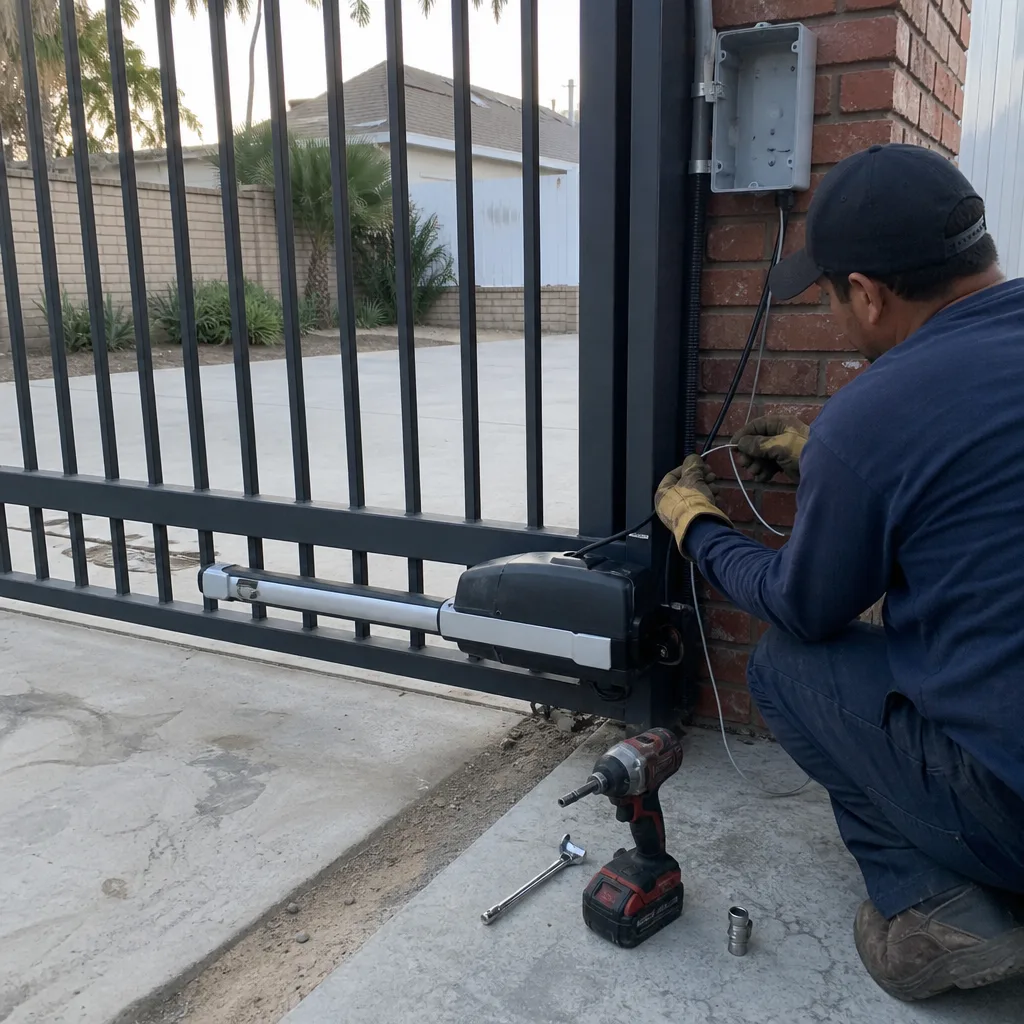
Gate repair in Huntington Beach is a coastal discipline. The same failure that would be unusual in Anaheim is ordinary in Surf City, and the technician who understands salt corrosion, sandy grit, and the specific failure profiles of swing, slide, and barrier gates will find problems the generic repairman misses. The single best thing you can do as a homeowner is demand evidence: a written price before work starts, a documented diagnostic with real readings, and a photographic record when the job is done. That’s what separates a professional repair from a part swap, and it’s the difference between a gate that works for years and one that fails again next season.
If your gate is acting up in Huntington Beach, call Vance Gate Repair at (657) 271-2877. A live person answers, the estimate is free, and the price is in writing before anyone picks up a tool.
Written by Adrian Vance, Owner at Vance Gate Repair Huntington Beach, serving Huntington Beach since 2014.